Opinion
Punjab: A murder in Mansa may have broken the spell of AAP
Parvinder Singh Jhota’s live feed ended on 13 Oct. But the story is still streaming and AAP may not like the ending
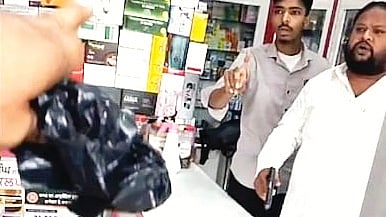
Punjab has seen many killings — perhaps never watched one live. On 13 October, at around 9.15 a.m. Parvinder Singh ‘Jhota’ walked into a chemist’s shop in Mansa, holding his phone out in front of him. It was the only weapon he carried.
For approximately four minutes, his followers on Facebook Live watched Jhota confront shop owner Ashwani Kumar, accusing him of selling nasha (drugs) to an elderly man. Kumar pulled out a pistol. “Maar mainu, maar mainu (kill me)," Jhota dared him. Three shots rang out, the phone tumbled to the floor, and the screen went dark.
Jhota means ‘bull’, a nickname that suited Parvinder to a tee. A former boxer and recovered addict, he had turned his own demons into the 'Nasha Roko, Rozgar Do' crusade. His anti-drug task force model was replicated by village committees across Mansa and Bathinda. Jhota’s method was crude but effective: walk in, camera rolling, and catch the chitta (drug) peddler red-handed.
His feud with Ashwani Kumar wasn’t new. In July 2023, Jhota and his supporters accused the chemist of selling banned drugs and paraded him through the market wearing a garland of shoes. Both were booked. Jhota spent months behind bars. Kumar, who reportedly faced at least five FIRs, walked away with an arms licence for a 7.62 mm pistol and a 12-bore gun.
The man who fought drugs went to jail; the man accused of selling them got a gun licence. That single irony did more to indict the system than a hundred press conferences. It laid bare the old triangle — politician, policeman, smuggler — that political scientists call an iron triangle and ordinary Punjabis simply call “setting”.
Within days of Jhota’s murder, the local SHO was suspended and the SSP claimed 138-plus cases had been filed against chemists in a single month. Why had they waited over three years to do that?
****
In the last four years, Mansa has given Punjab two ‘martyrs’. In May 2022, Sidhu Moosewala, gunned down in his car; now, Jhota, gunned down on camera. The emotional response, as it spills into the streets, has been strikingly similar.
While the SGPC (Shiromani Gurdwara Parbandhak Committee) has announced that Jhota’s portrait will be displayed in the Central Sikh Museum at Darbar Sahib, the family wants official martyr status and a statue in Mansa. A man the state had jailed is now being canonised by both the Panth and the public.
AAP’s first instinct was to do what it does best — manage the story. Police hinted at a ‘personal enmity’ between two old rivals. That did not wash: all of Punjab had seen the video. So, out came the bulldozers. In 24 hours, the administration was seen demolishing Kumar’s shop and residence. The crowd didn’t wait for ‘bulldozer justice’ imported from Uttar Pradesh to finish the job. They brought out the medicines, found capsules they claimed were prohibited, and set the place on fire.
The government’s much-advertised pre-election campaign is 'Yudh Nashian Virudh (war against drugs)'. More like yudh nasha rokan walian virudh (war against those who stop drugs), protesters said mockingly. Hoardings proclaiming an ‘Imaandar (honest) CM' were blackened, imaandar overwritten by beimaan (dishonest). For once, AAP’s war room lost the war of words.
There was another deeper irony. According to his friends, in 2022, Jhota had backed AAP’s Vijay Singla in Mansa, believing the party would crush the drug trade. Within months, Singla was sacked from the cabinet on corruption charges. Disillusioned, Jhota drifted away. When Singla finally visited the injured at Civil Hospital four days after Jhota’s killing, Nihangs and protesters chased him out. The man AAP once counted as an ally had become the face of the fury against it.
What started as a spontaneous expression of rage has quickly acquired the shape of a classic Punjabi morcha. A joint action committee is running a continuous dharna in Mansa. Opposition parties, kisan unions, ex-servicemen, employees’ bodies, civil society and a swarm of social media influencers have joined in. The Punjab bandh of 15 October was a united show of strength rarely seen since the farm agitation. Markets downed shutters from Amritsar to Zirakpur and highways fell silent.
On 19 October, the morcha carried its lahnat pattars (letters of condemnation) to the doorsteps of all 92 AAP MLAs. Not one legislator came out to receive them. Sukhveer Singh Maiserkhana, expelled from the party, emerged to accept his and admitted AAP had erred. Talks held the same day between the family and senior IAS officers ended without a breakthrough.
Then the government blinked. On the morning of 20 October, hours before Amit Shah landed in Punjab, chief minister Bhagwant Mann announced on X that the case was being handed to the CBI, ‘respecting the family’s demand’. This from a party that has spent a decade calling Central agencies the BJP’s tota (parrot).
Shah made the most of it. He spent barely 20 minutes at Jhota’s home and turned the rest of the day into a political roadshow of grief. He called on the families of Bikramjit Singh in Gurdaspur and Gulzar Singh in Sangrur. Calling Mann’s regime an ‘aapda’ government, Shah declared that anyone who speaks against drugs in Punjab is no longer safe. The BJP, a marginal player in rural Punjab, wants to wave the chitta banner as its own.
This is precisely what the morcha has been wary of. It initially resolved to oppose Shah’s visit — the Border Security Force is, after all, answerable to the home ministry — before relenting at the family’s request. With everyone eager to carry Jhota’s arthi, the family is making sure no one hijacks what he stood for.
At the centre of it all stands Jhota’s father Bhim Singh, an ex-serviceman with a fauji’s resolve. When the SGPC offered fixed deposits of Rs 10 lakh each for his two grandsons, he declined, asking instead that help go to the four men injured alongside his son.
Like Balkaur Singh before him, he has turned private grief into public resolve. The CBI sop has not ended his vigil. Jhota’s body still lies in the mortuary, and the other demands remain unmet: resignations of the chief minister and DGP Gaurav Yadav, dismissal of the district’s police brass and a post-mortem at PGIMER, Chandigarh.
Until 12 October, AAP looked pretty comfortable. Its populist welfare model — free power, mohalla clinics, Rs 1,000 to women — had struck a chord. Mann’s ‘Teflon image’ had survived the beadabi controversy, corruption charges against his wife and confidants, and a host of other crises. With the Akalis split and shrunk, the Congress busy fighting itself and the BJP still fumbling for a rural base, its control of the narrative seemed tight.
The Jhota killing has exposed the fault lines of this model — a party that lives by the reel can also die by the reel. AAP leans on one man; when Mann’s credibility dents there is no second line to absorb the blow. Crucially, AAP has failed on the two issues that matter most to the Punjabi household — drugs and law and order.
Recent history should worry the party. In Punjab, governments are discredited on the street before being defeated by the ballot. A powerful civil society and an influencer ecosystem with viral reach has brought governments to their knees.
In 2015, Bargari and Behbal Kalan broke the Akali Dal; it crashed to 15 seats in 2017 and 3 in 2022. In 2020-21, the farm agitation discredited the traditional parties so thoroughly that AAP swept to power with 92 of 117 seats. AAP rode the last great wave of street anger into office. The question now is whether this wave will sweep it out.
With elections only four months away, the arithmetic is unforgiving. If the agitation continues — with a body in the mortuary, a father on dharna and a video playing on every smartphone — it could do to Bhagwant Mann what Bargari did to the Badals. Jhota’s live feed ended on 13 October. The story is still streaming and AAP may not like the ending.
Join our official telegram channel (@nationalherald) and stay updated with the latest headlines