Opinion
The full worth of citizens as custodians
Ali Khan Mahmudabad urges our young protestors to see what binds them with the grievances of other Indians, to find a shared moral code
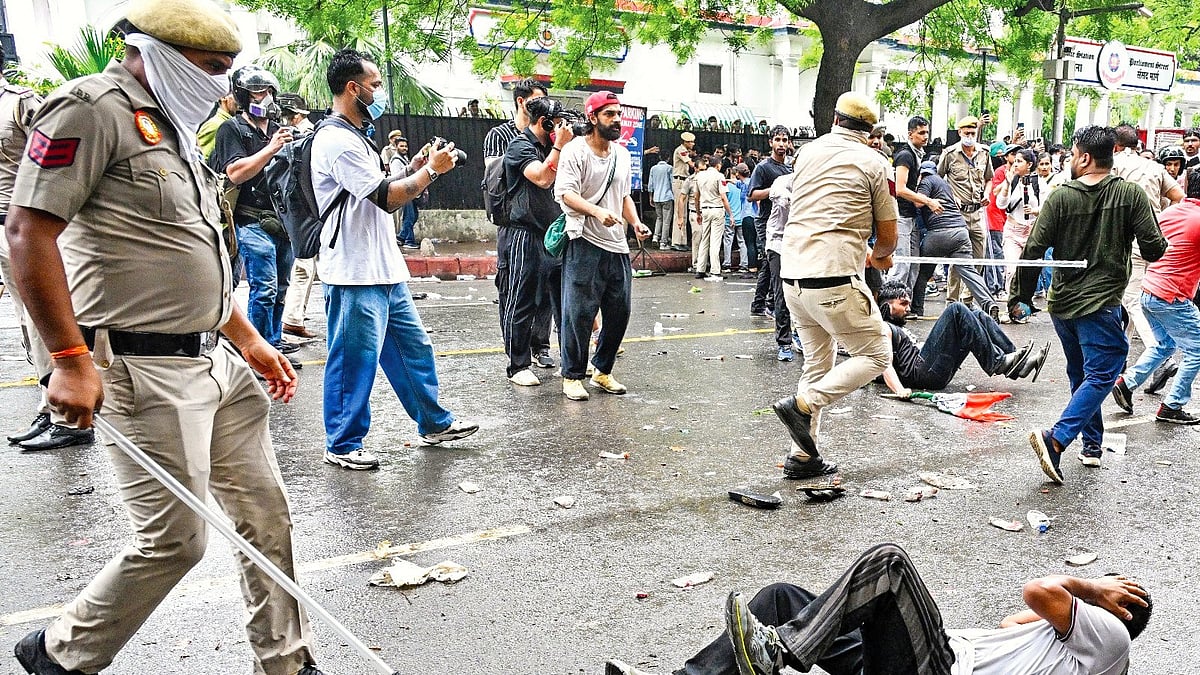
Protests are awakenings. Whether for those who acknowledge the folly of their previous actions or those who think they are apolitical or even those who always thought that the state only targets troublesome people on the margins of society.
There are many protests happening across India, but the one that has caught the imagination of millions of young people still in their teens or early 20s is the ongoing protest against the NEET exam paper leaks.
With the farmers moving in on Delhi and the prime minister admitting paper leaks are a ‘grave sin’ while also suggesting that protestors are on ‘the wrong path’, the ingredients for a larger movement exist: a widespread grievance (paper leak), no redress (demand for accountability), a common goal (resignation of the minister concerned), a catalyst (Sonam Wangchuk’s fast and his forced eviction from the protest site), mobilisation (thousands of supporters from across the social and political spectrum) and a spark to reignite a wider protest (the State’s crackdown).
It is crucial to understand that the NEET paper leaks or the CBSE evaluation scandal are not isolated problems but manifestations of a broken system. Even if education minister Dharmendra Pradhan resigns, the families of those who died by suicide are compensated and politicians address these issues in Parliament, it will at best be cathartic; it won’t fix the system.
What the youth — they are not ‘children’, by the way — must realise is that they can ride this moment to ask for more, they can act as interlocutors of other protests happening across the country.
Farmers in Punjab, Haryana, Rajasthan, Himachal…
The still simmering labour unrest in the NCR
ASHA workers and labour unions in Haryana
Tribal women (and men) in Madhya Pradesh resisting the Ken-Betwa river linking project
Chipko 2.0 against the proposed felling of 4,000 trees in Uttarakhand
Students trying to save large parts of the Jauhar University campus in Uttar Pradesh
Farmers protesting acquisition of their land to build an AI township in Karnataka
Villagers protesting the demolition of 70 homes to build flats for MLAs in Chhattisgarh
Employees of a cooperative bank protesting for better wages in Tamil Nadu
Aspirants to the state’s public service commission protesting in Maharashtra
Women vendors sitting on an indefinite strike against the arrests of village volunteers in Manipur
The Bahujan community protesting the murder of a young girl in Uttar Pradesh
For the most part, people will view all these protests as disparate. But even though the lifeworlds of these people might be wildly different, it is evident that they are all reacting to an overly cen-tralised and unaccountable state that relies on technocratic solutions provided and upheld by corrupted institutions. This, in turn, concentrates power and money at the cost of federalism, the environment, civil liberties, fundamental rights and even basic human dignity.
Citizens are losing agency over their lives. Indeed, the very idea of citizenship has become fraught with ambiguity. The question that follows is not what ideologies these groups might share but how they view each other and talk to each other. The first step is to stitch and mend our social fabric and not to think in terms of political alliances. The challenge is first social, and only then political.
Today, the distance between these communities is not just geographic but emotional. Social media has inured us to the suffering of others. It has also created echo chambers that reinforce our own victimhood. We no longer know how to talk to one another, let alone imagine what we may have in common.
On the face of it, a Muslim facing a bulldozer might have nothing in common with a Hindu agitated about the embezzlement of Ram Mandir donations. Maharashtra public service commission aspirants may see tribals in Madhya Pradesh as anti-progress. Farmers in Gujarat might see farmers in Punjab as anti-national. Kashmiris might feel that everyone had it coming.
What is needed is a politics of translation, not simply shared ideology nor even passive solidarity. No decisions without the equal participation of all stake-holders — this would resonate with the Kashmiri desiring statehood and the Karnataka farmer who refuses to give up her land despite being offered crores. The grievances are different; the principle remains the same. The protests today are partly the result of having always viewed the problems of others as unrelated to ours.
Historically, the JP movement and the India Against Corruption movement were important in that they were umbrella movements. The failure of the JP movement was that while it used a moral vocabulary (‘Sampoorna Kranti’) to bring together diverse people who shared common grievances about the excesses of unbridled power, it did not articulate a shared philosophy to govern. It was oppositional by its very nature. The IAC also brought together groups that had little in common because it identified a shared problem: corruption. The failure was that it only held politicians accountable.
The reality is that the entire system of governance is corrupt and even citizens benefit from this.
Rather than searching for incremental solutions or ad hoc changes in policy, the young people who are dreaming of a better India must grapple with the challenge of finding a shared moral vocabulary.
How does one combine Savitri Bai Phule’s idea of education as care, Ambedkar’s idea of dignity, Lohia’s idea of the vigilant citizen, Gandhi’s idea of swaraj, Begum Rokeya’s idea of political awakening, Khan Abdul Ghaffar Khan’s idea of service and trusteeship, Ram Dayal Munda’s idea of coexistence with both people and nature and the Constitution’s promise of equal citizenship when we have all become so insular that we are concerned with only those issues that directly affect us?
Perhaps one answer lies in imagining all citizens as custodians of a trust. This trust is the plural idea of India that we have inherited, with its diverse peoples, traditions, religions, rivers and mountains, forests and deserts, animals and plants. This trust is the Preamble of our Constitution. Custodianship (sanrakshta) links us to the past but also fosters responsibility towards the future.
It refuses to see everything including relations between people through the lens of a State. It focuses on covenants not contracts; homes not markets; the future as much as the present. If citizenship bestows the individual with rights, custo-dianship encourages responsibility not just for ourselves but for everyone.
This past week ‘the future’ of India has been protesting in Delhi. It has also learned the costs of raising its voice. India does not belong to the government nor a community nor a party, but is a shared trust where maryada, ethical restraint, should determine the State’s relationship with the people. A good society is one in which all those who wield power — government, corporations, religious institutions, the bureaucracy and indeed citizens — act as custodians of a trust, bound by maryada.
Lord Ram is known as ‘Maryada Purushottam’, one of supreme ethical restraint. The ideal ruler limits themselves. The ideal ruler is not necessarily the strongest but one with great ethical restraint. When maryada is violated, what is held in trust comes under threat. It must be protected.
Ali Khan Mahmudabad is a writer, wayfarer and self-professed scoundrel
Join our official telegram channel (@nationalherald) and stay updated with the latest headlines