Opinion
The world according to Manmohan Singh
Edited excerpts of the inaugural Manmohan Singh Memorial Lecture by Dr Angela Merkel, former German chancellor, in New Delhi on 26 February
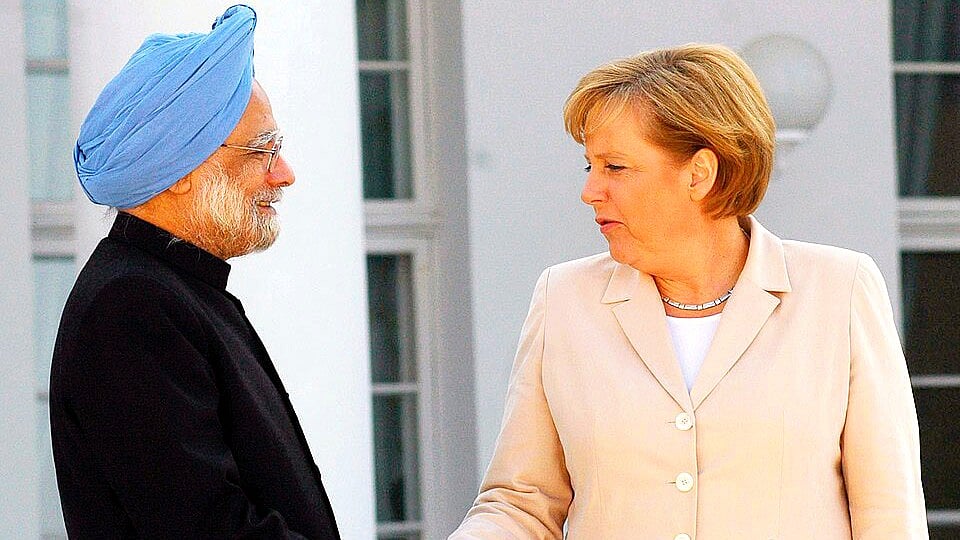
What interest can there be today in my speech in honour of Dr Manmohan Singh? After all, he became prime minister of India back in 2004, was in office till 2014, more than 11 years ago now, and I am a former chancellor of the Federal Republic of Germany who ended her active political career more than four years ago. Why did I nonetheless find it appealing and rewarding to accept Upinder Singh’s invitation on behalf of the Manmohan Singh Trust?
First and foremost: it was a great pleasure to work with Manmohan Singh for almost 10 years.
Manmohan Singh was a very special personality. I felt this immediately in our first encounter. I think everyone who knew him felt something similar: he could captivate people, even though he did not appear dominant in either his demeanour or his speech. He was more than 20 years older. We met for the first time in April 2006 in Germany for the opening of the Hannover Messe, the world’s largest industrial fair at the time, at which India was invited as the partner country and Indian companies could thus present themselves to the global public.
What impressed me about Manmohan Singh was his alert and curious gaze, which radiated experience and openness in equal measure. He seemed both composed (‘in sich ruhend’) and gentle as well as determined.
As the first prime minister of India who was not a Hindu and belonged to the Sikh minority, he embodied the pride of a nation that seeks its equal in religious, ethnic and geographical diversity. He did this without losing many words over it. He radiated authority without seeming intimidating and gave me the courage to ask questions and conduct open conversations.
In our conversations, he pointed out again and again, not reproachfully but firmly, the reservations emerging countries like India have about rich industrialised nations, including Germany. From then on, I engaged more closely with the conditions in emerging countries, including India, and the challenges these countries faced. In my political memoir, I describe how my view of the world sharpened through conversations such as those I had with Manmohan Singh.
On my desk in the Chancellery stood a globe, which served as geographical orientation during my phone calls with heads of government. At some point, I began to think about the difference between a globe and a map. In doing so, it became clear to me that my worldview, like many other Europeans’, was Eurocentric.
On a globe, the distance from every place in the world to the centre of the globe is the same; no place is highlighted. On a world map, it’s different — there is a centre and there are margins. Where the centre lies is arbitrarily determined. I grew up with maps where the second smallest continent on earth, Europe, is always at the centre.
This shaped my thinking from childhood. It became clear to me much later that Europe is not the navel of the world. But what for me was a late insight was for Manmohan Singh a truism from childhood.
The world has changed dramatically since the time Manmohan Singh was prime minister. The economic and political weight of the world has shifted from the G7 industrialised nations to emerging countries symbolised by the BRICS group. The shift was on the cards even during our time in office. What weighs more heavily today is that seemingly unshakeable certainties have in recent years been shaken. Let me name three:
In Europe, the principle of the territorial integrity of states was violated by Russia’s attack on Ukraine, throwing into turmoil the order established after World War II. The right to territorial integrity and the sovereignty of every member of the United Nations, enshrined in the UN Charter, was trampled underfoot.
Multilateralism is under pressure. The USA under President Donald Trump is leaving or weakening international organisations — WHO, WTO, the Paris Climate Agreement. They openly call into question the role of the UN and take unilateral action. The previous order of cooperation is being replaced by an order where, increasingly, the might of the strong will prevail over the strength of the law.
Add to this newer possibilities, courtesy social media and AI, which are capable of turning truths into lies and lies into truths. This has grave effects on our democracies and our coexistence in freedom.
Given these developments, we must wonder what principles should govern lives in the future — to coexist with other groups in society, in the education of children, in professional life. Also, whether it’s still worthwhile to commit oneself to democratic rules.
What does all this have to do with Manmohan Singh? Well, I believe that his work can re-orient us.
On 19 July 2005, Manmohan Singh delivered a speech in Washington to both houses of the US Congress. “The real test of a democracy,” he said, “is not what is said in the Constitution but how it functions on the ground.”
The indispensable features of a democracy, he said, with particular reference to India, are: free and fair elections on the watch of an independent Election Commission; an independent judiciary as guarantor of the rule of law and defender of the Constitution; a fearless press; the protection of minorities; the space for civil society organisations to work unhindered. Each of these, he said, was equally important for a functioning democracy.
What applied then applies even more today. Democracy is under pressure, certainly in Germany. It’s now up to individuals to make no compromises with what we regard as essential to (democratic) order. We must be prepared to take a stance publicly, to not back away from hate and incitement on the internet or from controversial discussions. On this will depend whether we can continue to live in freedom.
We can no longer take the democratic order as an unshakeable truth, as a given. Whatever important countries on our planet do, we must re-commit ourselves to multilateral cooperation. Manmohan Singh underlined this in various UNGA speeches.
In one of these, in September 2013, he said member states are best served when they adhere to the letter and spirit of the UN charter. By which he meant striving for the broadest possible consensus of the international community and, in doing so, balancing fairly the needs and responsibilities of nations in different stages of development.
Global challenges such as man-made climate change and the protection of biodiversity imperatively require collective action by the world community. India and Germany are both signatories to the Paris Climate Agreement, and to the principle of the common but differentiated responsibility of various states.
The latter principle was particularly important to Manmohan Singh as prime minister of an emerging country, but in underlining this, he was speaking for all developing countries. We agreed that a life of peace and security was possible only if growth was inclusive.
On the challenges of globalisation, manifest especially after the financial crisis of 2008 — when economic recession hit industrialised countries and caused economic upheaval in emerging economies as well — [MMS] believed that difficulties can only be overcome with a cooperative approach, not a confrontational one.
Today, as protectionist trade practices hinder the growth of the world economy, his warnings are of great importance — for it is the poorest countries and the poorest in the emerging countries that suffer the most.
Finally, if technological developments are fundamentally changing life everywhere, then these technologies must also be subject to multilateral agreements and regulations. This applies equally to the protection of personal and economic data, to the devolution of responsibilities in social media and to the regulation of the expanding sphere of AI.
It may seem utopic in the present circumstances — when leaders in the field are either setting their own rules (China) or preventing any regulation (the US) — but multilateral cooperation is necessary in these areas as well.
In view of the challenges our societies face in a changing world, I think Manmohan Singh’s maxims and his political work can still be a guiding light and inspiration.
Join our official telegram channel (@nationalherald) and stay updated with the latest headlines