Opinion
What should Democrats do with their win?
United against Trump, the party’s next big battle is within its own ranks, writes Ashok Swain
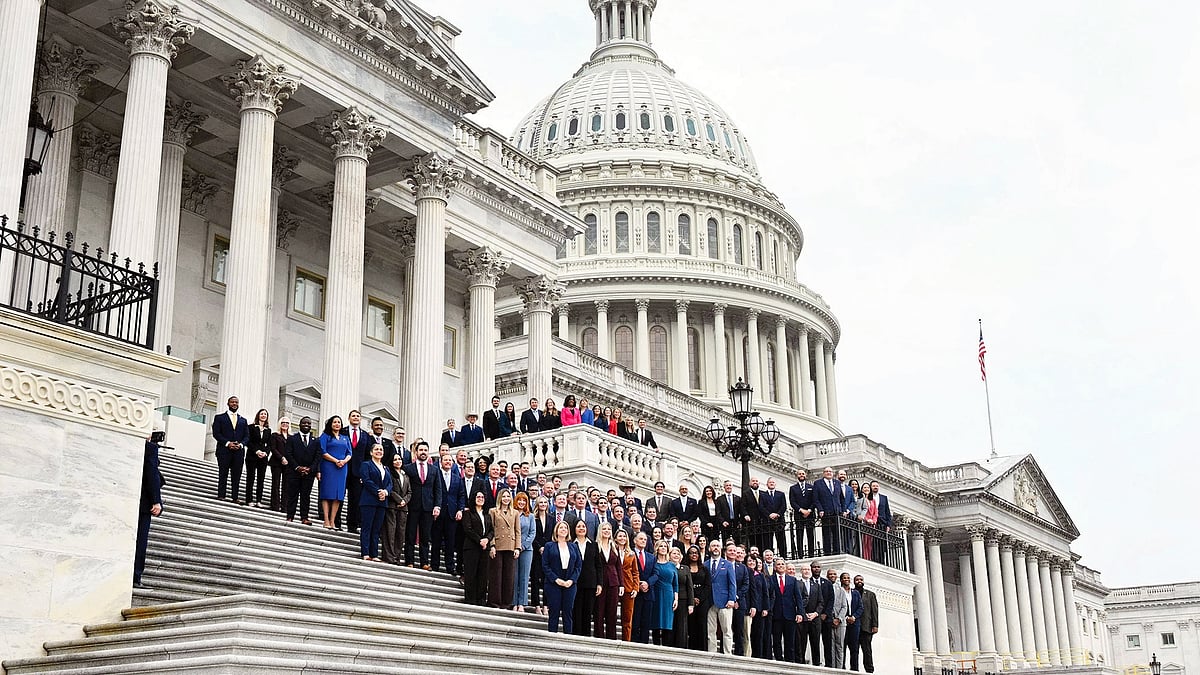
The Democrats have won a spectacular electoral victory, but its biggest battle may now be within its own ranks.
This month's midterm elections have delivered control of both houses of Congress to the Democrats, inflicted a humiliating defeat on Donald Trump’s Republican Party, and dramatically altered the political landscape ahead of the 2028 presidential election.
Yet beneath the celebrations lies an uncomfortable question: have American voters endorsed the Democratic establishment, or have they simply rejected Trump’s increasingly unpopular presidency? The answer will determine not only the party’s political future but also whether Washington’s longstanding foreign policy consensus, particularly its unconditional blind support for Israel, can survive.
The scale of the triumph is extraordinary. From Texas to Alaska, Kansas to South Carolina, the party has made inroads into Republican territory previously considered impregnable. Texas has elected a Democrat senator for the first time since 1988.
Progressive candidates have succeeded alongside moderates, suggesting that voters were less interested in ideological labels than in candidates offering credible responses to their economic anxieties. The continuing war with Iran, rising living costs, punitive tariffs and aggressive immigration enforcement helped turn public frustration into an electoral earthquake.
But electoral victories often conceal contradictions that become visible only when the celebrations end. The Democratic coalition now stretches from democratic socialists demanding structural economic transformation to conservative Democrats representing traditionally Republican constituencies. Their shared opposition to Trump should not be mistaken for agreement about what comes next. Winning against an unpopular president is considerably easier than constructing a governing programme capable of satisfying such different constituencies.
This is where the party’s established leadership faces its greatest challenge. Chuck Schumer and Hakeem Jeffries represent a generation of politicians accustomed to managing competing interests through unprincipled compromises, powerful donors and party discipline. That approach may have helped hold the party together, but younger voters and increasingly assertive progressive activists are questioning whether it can deliver the changes they expect.
Their dissatisfaction is not merely about personalities. It concerns a political culture that promises transformation during elections but frequently retreats into caution once power is secured. The challenges from progressive forces to the leadership may not succeed immediately, but they reveal something significant: the Democratic establishment can no longer take the loyalty of its own political base for granted.
The argument is also about what Democrats should do with their victory. Moderates point to impressive performances by candidates such as James Talarico in Texas and Roy Cooper in North Carolina as evidence that electoral success requires appealing beyond progressive strongholds. The Left counters that economic populism, criticism of billionaire influence and opposition to endless wars helped mobilise voters across ideological boundaries.
Both interpretations contain elements of truth. The real question is whether Democrats can combine economic radicalism with electoral pragmatism rather than treating them as mutually exclusive.
The approaching presidential contest will intensify these disagreements. Potential contenders, including Alexandria Ocasio-Cortez, Pete Buttigieg, Jon Ossoff and other emerging Democrat figures, will have to articulate something more substantial than opposition to Trump.
The 2028 primaries could become the party’s most consequential ideological confrontation in decades. Unlike 2024, when Democrat voters were denied a genuinely competitive nomination process, the next contest offers an opportunity to debate the party’s identity and its relationship with corporate power, militarism and America’s changing electorate.
Nowhere will this confrontation be more consequential than over Israel. For generations, unwavering support for Israel has remained one of the few areas of bipartisan agreement in Washington. Democratic and Republican administrations have differed over settlements, Palestinian statehood and negotiations, but the underlying commitment to Israeli military domination has remained largely untouched. Even when Israeli governments openly defied American diplomatic preferences, Washington continued supplying weapons and providing diplomatic protection.
That consensus has been eroding. Israel’s devastating military campaign in Gaza, the humanitarian catastrophe suffered by Palestinians and the subsequent expansion of regional warfare has profoundly altered the debate within Democratic politics. Younger Americans increasingly question why their government should finance military operations while claiming to defend human rights and international law. For them, Palestinian suffering is not a distant diplomatic complication but a test of US political morality.
The war with Iran has sharpened these contradictions. Trump’s military intervention, undertaken despite his earlier promises to avoid costly foreign entanglements, has imposed economic and strategic costs on Americans already struggling with inflation. The connection between overseas warfare and domestic hardship has become politically unavoidable. When voters see rising fuel prices alongside enormous military expenditures, arguments about protecting distant allies acquire a different meaning.
Significantly, criticism of Washington’s relationship with Israel is no longer confined to the Democratic left. Sections of the Republican coalition, including figures associated with vice-president J.D. Vance, are questioning whether American interests should remain so closely tied to Israeli military ambitions. This emerging convergence does not signify agreement over Palestinian rights. Nevertheless, it suggests that the traditional bipartisan consensus is facing pressure from both directions.
For Democrats, the immediate test will come when the new Congress convenes in January 2027. Control of both chambers gives the party substantial powers over appropriations, investigations, military assistance and presidential appointments. Congressional committees can scrutinise weapons transfers, examine the conduct of the Iran war and demand accountability for civilian casualties.
But congressional control should not be confused with control of foreign policy. Trump remains president, retains extensive executive authority and can veto legislation. Democrats lack the numbers necessary to override presidential vetoes or easily overcome Senate filibusters. Moreover, their own caucus remains divided over how far Washington should go in confronting Israel. A dramatic rupture is unlikely before 2028.
There is, however, considerable room between unconditional support and abandoning an ally. Democrats could insist that military assistance comply with existing American laws, oppose settlement expansion, demand humanitarian access to Gaza and reject further military adventures undertaken without congressional authorisation. They could also make recognition of Palestinian self-determination a substantive diplomatic objective.
The greater obstacle may be political money. Pro-Israel organisations, defence contractors and wealthy donors have long exercised considerable influence over US elections. Challenging that requires more than rhetorical sympathy for Palestinians. It demands a willingness to confront the financial arrangements that sustain Washington’s foreign policy establishment. For politicians accustomed to expensive campaigns, such independence carries substantial risks.
Refusing to change carries risks of its own. Democratic voters, particularly younger progressives, may not indefinitely accept a party that champions racial equality and human rights domestically while defending policies abroad that appear fundamentally inconsistent with those principles. The contradiction has become too visible to be managed through carefully worded statements expressing concern about civilian suffering.
The Democratic Party now stands at a historical crossroads. Its electoral triumph has weakened Trump politically, but it has also exposed the limitations of the leadership that delivered victory. The coming struggle is not simply between moderates and progressives. It concerns whether the Democratic Party can move beyond defending the institutions and policies that helped produce widespread public disillusionment.
Ashok Swain is a professor of peace and conflict research at Uppsala University, Sweden. More by the author here
Join our official telegram channel (@nationalherald) and stay updated with the latest headlines