Opinion
Why Trump’s America is a lonely superpower
Trump’s America is still able to project force but it no longer commands respect, writes Ashok Swain
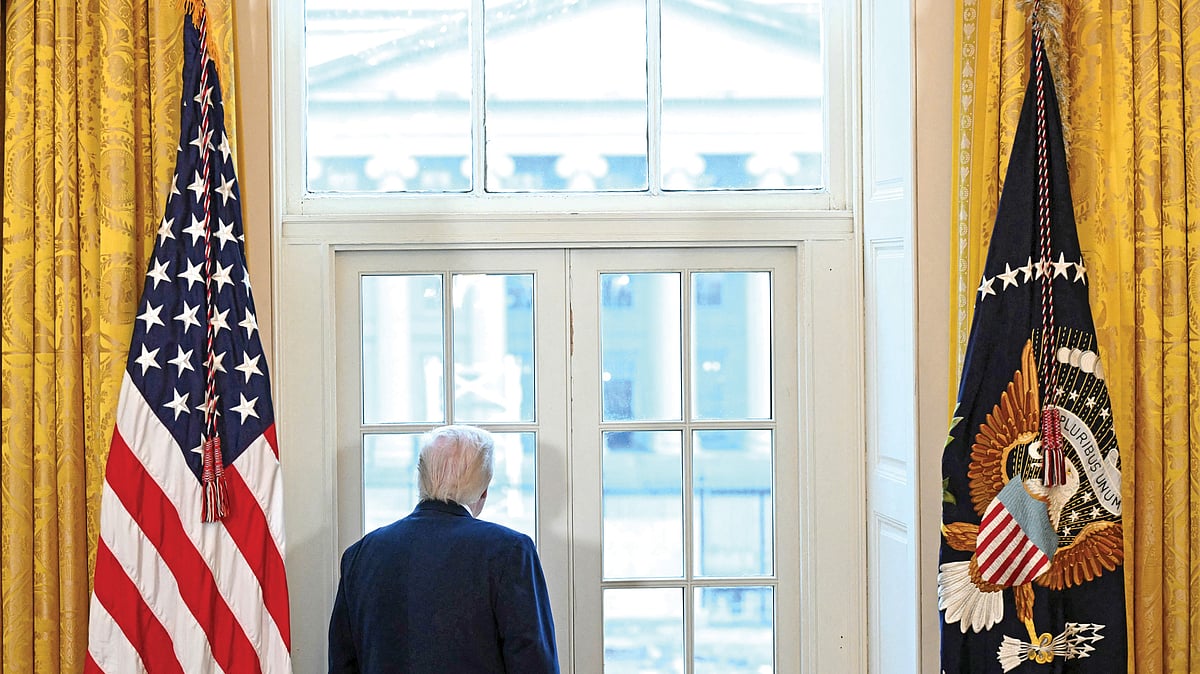
Great powers sometimes isolate themselves through overreach. The United States under Donald Trump is in that zone. By aligning reflexively with Benjamin Netanyahu on almost everything — from Palestine to Lebanon to Iran — Trump has really damaged America’s pre-eminent stature in world affairs.
As a superpower on the wane, Trump’s America is still able to project force but it no longer commands respect, it cannot build consensus and will possibly, after the Iran debacle, not even instil fear as it once did.
Recent developments in the Persian Gulf capture this shift quite starkly. After failed negotiations in Islamabad, Washington has lurched towards measures that threaten to disrupt one of the world’s most vital oil, gas and nitrogen corridors and escalate the conflict far beyond its current boundaries. The message to the world is unmistakable: the United States is prepared to act alone, even when the consequences are global and there is widespread opposition.
The more fundamental concern is not one single decision, but the general drift of US policy. Trump’s West Asia policy has fused American decision-making with Israel’s war objectives to an unprecedented degree, the kind of convergence that leaves little room for independent judgment. And it is precisely this convergence that is driving Washington’s isolation.
The damage was visible even before the war with Iran, and what started the rupture was America’s open backing of Israel’s genocidal, ethnic cleansing project in Gaza. The war with Iran has further strained alliances across Europe and Asia, weakening partnerships that took decades to build while opening space for rivals like China and Russia to expand their influence. As Washington increasingly prioritises military solutions, it weakens the very networks that have historically extended its influence.
Nowhere is this more clear than in the Gulf. For years, the Gulf states relied on the US as a guarantor of their security, even when they disagreed with its policies. That relationship is now fraying. The war has left them exposed, economically vulnerable and strategically uncertain. Instead of stabilising the region, US actions have heightened their sense of insecurity.
Even as Trump claims success, Iran has emerged more powerful, with significant leverage over the Strait of Hormuz, the artery that controls at least 20 per cent of the world’s trade of crude oil and LNG and about a third of global seaborne trade in fertilisers and key feedstocks.
Washington appears unresponsive to the concerns of its allies. The Gulf states are worried about being dragged further into a confrontation they didn’t start nor can control and will certainly not benefit from. The perception that Netanyahu is leading Trump by the nose, that US policy is driven primarily by Israeli priorities and Netanyahu’s obsessions rather than any concern for regional stability has deepened that unease. It is one thing to support an ally, quite another to be a captive to its agenda.
The war with Iran has reinforced this perception. The strikes did not follow failed diplomacy; they came amid ongoing negotiations, reinforcing longstanding global suspicion that the US treats diplomacy as a ruse rather than a commitment. That matters. When negotiations are repeatedly undercut by military action, trust collapses. And without base-level trust, diplomacy becomes impossible.
Across the Global South, the war with Iran is seen as a ‘war of choice’; some observers have even called it a ‘war of whim’, a military superpower trying to bully a weaker adversary. This perception feeds into a broader narrative that the so-called rules-based order is selective and self-serving. When Washington invokes international law or nuclear non-proliferation against its adversaries but ignores it when convenient, it carries no moral authority.
That loss of authority is already reshaping global alignments. Countries that once looked up to the US as a stabilising force are hedging their bets. Some are moving closer to China, which presents itself as a more predictable partner. Others are simply stepping back, choosing not to align too closely with any major power. Even close allies such as the UK, France, Japan, Germany and South Korea are increasingly diverging from the US in their voting patterns at the United Nations.
Trump’s defenders argue that strength, not consensus, is what matters. But this argument confuses coercive power in the short term with long-term influence. Military superiority can win some battles but it cannot sustain an international order or superpower status. That requires legitimacy, cooperation and a willingness to respect rules and norms.
The contradictions in US policy are now impossible to ignore. Washington may not have fully abandoned the language of diplomacy — it still calls for negotiations, ceasefires and suchlike — but its actions fly in the opposite direction.
This has consequences. It becomes harder for the US to act as an honest broker in any conflict, or rally allies around shared goals or indeed convey that American leadership can think beyond narrow, immediate self-interest.
The cracks are widening even in the West. European governments, even NATO countries, may not have openly broken with Washington, but their discomfort is evident in calls for restraint and renewed diplomacy. Trump has even managed to pick a fight with the Pope, which will likely antagonise sections of his Christian base at home.
Despite the Senate vote in his favour, popular support is low for a prolonged war in West Asia. The war has not delivered the decisive outcomes it promised. Iran’s regime is intact, possibly stronger than it was before the war. Its regional influence is undiminished and it has successfully exercised leverage over a key strategic chokepoint in seaborne trade.
Instead of coordinating with allies and testing the path of diplomacy with Iran, Trump took the path of maximal pressure and no consultation and backed a rogue regional actor without question. The result is a superpower with no friends and no real allies. Trump’s America is a military superpower alright but its diplomatic cachet has all but evaporated.
Ashok Swain is a professor of peace and conflict research at Uppsala University, Sweden. More by the author here
Join our official telegram channel (@nationalherald) and stay updated with the latest headlines