Opinion
Why Saraswati Puja in Bangladesh matters to India
By all accounts, Saraswati Puja this year was celebrated on a larger scale with mass participation of both Hindus and Muslims
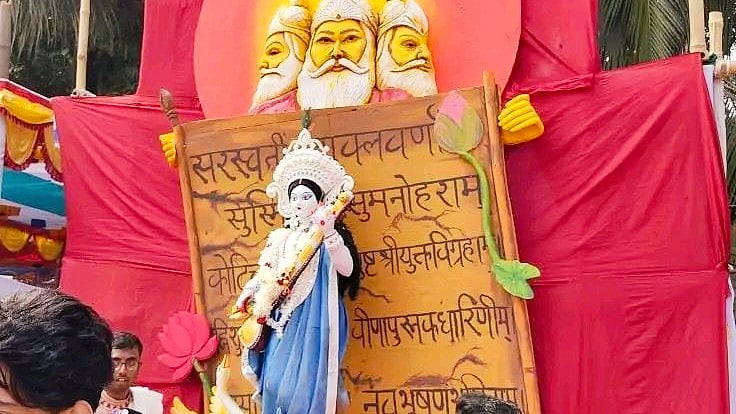
It was a pleasant surprise this week to stumble upon a steady stream of vivid photographs and videos of Saraswati Puja being celebrated in Bangladesh. Shared by a Bangladeshi handle on X, they were an eye opener.
Having visited the country and followed Bangladeshi media for several years, I was acutely aware that reports of persecution of Hindus in our neighbouring country were exaggerated. Yet nothing had prepared me for the images of vibrant colour and joyous celebration of the Hindu festival in ‘Islamic’ Bangladesh.
It came as a surprise to find there was an ‘official’ government function on the occasion in Dhaka, attended among others by the high commissioner of India to Bangladesh. I had not known about what the handle described as a ‘truck rally’ — a procession of trucks — with idols in Comilla, accompanied by music, dancing and drummers. It was fascinating to see the elaborate decorations that borrowed from the rich Bangla literature on both sides of the border.
The scale itself was staggering. All 74 departments in Dhaka University, this handle posted, put up their own idols with donations raised by students and teachers. Each department apparently chipped in with funds from their budget. The public celebrations were attended by Muslims, Christians and Buddhists besides Hindus. Each department displayed their work and what they study. There were the idols put up by departments of fine arts and literature, but also by departments of engineering and micro-biology.
It was, as expected, a riot of colours with graceful women in elegant saris, young couples holding hands, and entire families turning up with toddlers perched on shoulders. The handle shared short interviews with Muslim students who saw nothing amiss in attending a Hindu festival. The goddess of learning, they suggested, did not discriminate between one religion and another, and argued that this was part of their culture, part of their life.
I was reminded of Shashank Shekhar. In 1992, he was training to be a classical vocalist. He turned out to be equally passionate about cricket and ended up as a sports journalist with the Times of India. Bewildered by the wave of communal hatred unleashed before and after the demolition of the Babri Masjid, I recall him exclaiming, “All my gurus happen to be Muslim and each of them begin their riyaaz with Saraswati vandana; what does this Hindu-Muslim divide even mean?”
As it so happened, a report in The Telegraph, Calcutta on Saturday, the day after Saraswati Puja, began with these words: “Rajibul Rahaman returned to his hostel room groggy-eyed at dawn on Friday, after spending the night setting up the Saraswati Puja pandal with several hostel mates, including twin brothers Sarifuz and Arifuz Jaman, Souren Mallik and Prithwish Mutsuddi.”
All are students of Presidency University in Kolkata, hostellers at the iconic Eden Hindu Hostel. The Telegraph report reminded us that the hostel — built in 1886 and which began admitting Muslim students only around the turn of the century in 2000-01 — was a stone’s throw from the BJP headquarters in central Kolkata.
'This hostel was shut down in 2015 for renovation and boarders were shifted to a premise far away in Rajarhat. After a 70-day agitation, we fought our way back here in 2022. Saraswati Puja and iftar were started as a mark of celebration,' recalled Rajibul, a postgraduate student in life sciences who checked in just after the agitation.
“Pointing to Room 207 on the first floor, where India’s first President, Rajendra Prasad, spent five years as a student under British rule, the boys said, 'If they could fight for the country unitedly, why can’t we hold a puja or an iftar together in the same hostel?' Dhendu Bhutia from Kalimpong and Jules Boudet, an exchange student from Sciences Po, Paris, too did not look out of place in their kurta and pyjamas."
I waded through newspaper reports from Bangladesh to find some confirmation of the social media posts. There were several reports explaining the significance of Basant Panchami and why toddlers were initiated into writing on the auspicious day. The reports from Dhaka quoted Jagannath Hall provost Debashis Pal and Sadhan Chakrabarty, the priest of Jagannath Hall mandir.
They also reported that the puja was arranged at Dhakeshwari National Temple, Ram Krishna Mission, Jagannath University, Siddheswari temple, the Supreme Court premises, Eden Girls' College, Ramna Kali Mandir and Maa Anandamayi Ashram — all in Dhaka — besides other educational institutions in the city.
What also caught my eye was this passage in one of the reports: 'On Dhaka University campus, the Puja was organised at all female dormitories — Rokeya Hall, Samsun Nahar Hall, Bangladesh Kuwait Moitri Hall, Begum Fazilatunnesa Mujib Hall and Kabi Sufia Kamal Hall.'
It is possible that the puja in Bangladesh this year was celebrated on a larger scale as a ‘confidence building measure’ before the national election scheduled for 12 February. The celebrations, however, served as a timely reminder of the syncretic culture of Bengal.
There are indeed radical elements in Bangladesh and the same handle on X informs that these elements were not happy with the large-scale participation of Muslim students and teachers. There are other reports in Bangladeshi media which acknowledge the threat to Hindu minorities and the ‘safety’ promised to them by the Islamist Jamaat, if they win the February election.
Most of these Hindus, who were Awami League supporters, are likely to vote for the Jamaat and not the more overtly secular BNP, it would appear from these accounts.
However, alarmist and exaggerated reports of minority persecution in Bangladesh serve no purpose. They impress no one, thanks to our own record. That is why the reports from both Dhaka and Kolkata on Hindus and Muslims celebrating Saraswati Puja are so heartening. There is still hope for us.
Join our official telegram channel (@nationalherald) and stay updated with the latest headlines