POLITICS
Looking for the Opposition in Maharashtra
Jaideep Hardikar on the existential crisis of the two major regional opposition parties in the state and the space for an alternative
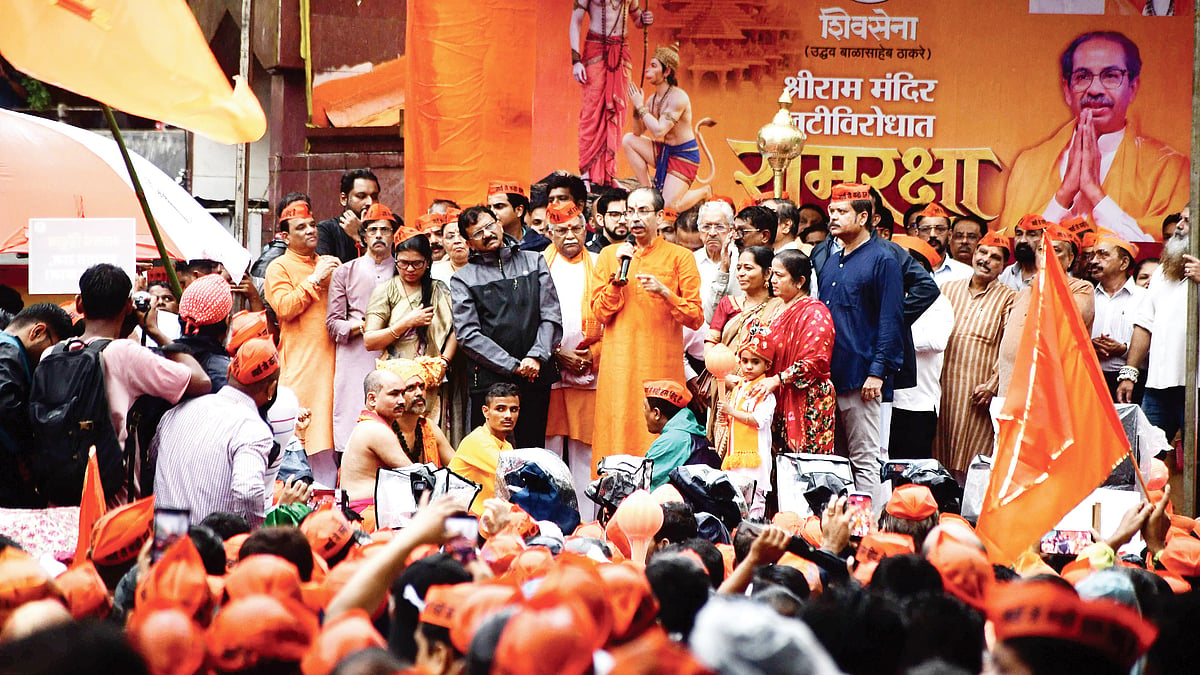
On a humid Sunday morning, just before heavy rain drowned Mumbai, Uddhav Thackeray stood before his party workers and supporters, reciting the Ram Raksha stotra. This was not an election campaign. After yet another round of desertions by his party’s Lok Sabha members, Thackeray was leading a ‘Ram Raksha andolan’ to protest the alleged embezzlement of donations by the BJP/RSS-backed trust managing the Ram temple in Ayodhya.
Standing amid saffron flags, he accused the BJP of exploiting the faith of millions of Hindus and declared that “Hindus are innocent, not foolish.” The symbolism was unmistakable: a leader who has spent the last four years fighting politically and legally to retain his party’s identity and control was returning to the ideological terrain that his father, late Bal Thackeray, had cultivated for decades. Yet beneath the chants and the verses lay a deeper anxiety.
The protest was less a confident assertion of ideology than a weak, almost desperate effort to reclaim political ground that has steadily slipped away since the rebellion of 2022 by his trusted aide-turned-bête noire Eknath Shinde. Shinde continues to eat into Sena (UBT), enticing its MLAs, MPs and foot soldiers to join his fold to enjoy the fruits of power. The latest defections — six of the nine members elected in 2024 on Sena (UBT) tickets and one MLC close to Aaditya Thackeray — underline the same trend.
Late last year, Sena (UBT) finally lost control over the prized Brihanmumbai Municipal Corporation (BMC) with the BJP–Shinde Sena–NCP (Ajit Pawar) combo sweeping the elections. Electoral losses aside, every defection or rumour that another legislator is switching sides chips away at the confidence of a party that has already lost its name, its election mascot, much of its legislative strength and a sizeable part of its organisation.
****
The crisis, however, extends beyond one party. Maharashtra today finds itself with perhaps the weakest opposition it has had in its history. The fragmentation of its regional parties has produced a legislature where the ruling alliance has overwhelming dominance, while those expected to challenge it are preoccupied with just staying alive.
The Opposition alliance has only 46 MLAs in a 288-member house if you count only the three MVA (Maha Vikas Aghadi) constituents. Neither the Sena (UBT) with its 20 MLAs nor the Congress (with 16) nor the NCP (Sharad Pawar) with 10 meets the one-tenth threshold (of 29 MLAs) required for a party to claim the statutory post of leader of the Opposition. This is the first time in about six decades that the Maharashtra Assembly has no LoP. It shows in the way legislature proceedings are conducted, with no serious discussion on any public issue.
The political vacuum may create an opening for the Congress, the only national party with a presence, however weak, across the state, but it’ll be a long haul.
****
As his party continues to bleed MPs, MLAs, corporators and local office-bearers, driven by the allure of power and big contracts, the big challenge for Uddhav Thackeray is to convince loyalists and fence-sitters that his party still has a viable future. Politics ultimately rewards confidence. Cadres stay with organisations that appear capable of winning elections, protecting careers and distributing political opportunities.
The party’s greatest asset today is Uddhav Thackeray’s personal credibility. Son Aaditya is not yet ready to take on the mantle. Unlike many contemporary politicians, Uddhav is perceived as measured and dignified. His handling of the Covid-19 pandemic earned him goodwill beyond his traditional support base. Many sympathised with him after the Shinde rebellion, but sympathy cannot sustain a political organisation.
The Shiv Sena that Bal Thackeray built was not an electoral machine. It was an intricate network of shakhas, neighbourhood organisers, trade unions, municipal institutions and loyal Shiv Sainiks. That’s the reason why when Raj Thackeray or leaders like Narayan Rane left the party in the 2000s, the Sena did not suffer the way it does today. Its strength lay in everyday presence rather than periodic election campaigns. Control over civic bodies, particularly in Mumbai and the Mumbai Metropolitan Region, buttressed this network for decades.
Much of that organisational architecture has been eroded beyond repair. And Uddhav Thackeray has not been able to seriously go back to the drawing board to resurrect his party’s shakha system by infusing new blood. Rebuilding that structure demands patience, clarity of purpose and resources — all hard to find and sustain in the midst of an existential crisis.
Equally troubling is the question of identity. What exactly does the Shiv Sena (UBT) represent today? The politics of Hindutva has a first claimant and Uddhav’s party has neglected its regional, ‘Marathi manoos’ plank.
Under Bal Thackeray, the Sena had ideological clarity, however polarising its cocktail of Marathi regionalism plus Hindutva plus a distinctive street cred. Uddhav Thackeray tried to reposition the party after 2019 by joining hands with ideological rivals in the interest of governance. That decision may have been politically necessary at the time, but it also altered the party’s image in ways that remain unresolved.
Is the Sena (UBT) primarily a Marathi regional party? Is it a moderate Hindutva formation? Is it now a broader secular regional force? Or is it defined mainly by opposition to the BJP? Political workers require ideological direction as much as electoral strategy. Voters, too, seek clarity. A party constantly explaining what it is not will struggle to convince people about what it really is or stands for.
Sharad Pawar’s Nationalist Congress Party (SP) confronts a quieter version of the same crisis. Pawar is one of India’s most experienced politicians and continues to command great respect. But his personal stature cannot indefinitely compensate for organisational erosion. Like the Sena (UBT), his party too lost its recognised name and symbol after the split.
Questions about succession persist. The organisation survives substantially because of the veteran’s own authority rather than an institutional structure capable of renewing itself independent of him.
The combined effect is unprecedented. Maharashtra’s two major regional opposition parties are simultaneously engaged in battles for organisational survival. Instead of challenging the government inside and outside the legislature, they are preoccupied with retaining their legislators, local leaders and workers.
****
Their predicament has created space for the Congress, which has something its regional allies lack at this moment — organisational continuity. It has not suffered a major split. Its district committees remain intact.
The party has, in fact, got fresh blood with newly appointed presidents of local units under its nationwide organisational revamp campaign — the Sangathan Srijan Abhiyan. Whether the campaign succeeds in rebuilding the Congress bottom-up is a different question, but its ideological identity is relatively stable. Most importantly, it is not burdened by questions like which faction represents ‘the real party’.
This does not automatically translate into electoral revival. The Congress has organisational weaknesses of its own and has struggled to convert public discontent into political gain. Yet, if Maharashtra seeks a durable and recognisable Opposition, the Congress may increasingly find itself occupying that space, less so at this point because of any great resurgence and more because the other claimants to that role have steadily fragmented.
Jaideep Hardikar is a senior Nagpur-based journalist and author of Ramrao: The Story of India’s Farm Crisis. More by him here
Join our official telegram channel (@nationalherald) and stay updated with the latest headlines