POLITICS
West Bengal: Governor’s sudden exit raises spectre of President’s Rule
An incomplete SIR and a controversial gubernatorial change mean all eyes are on ECI visit to the state on 9 March
The full team of the Election Commission of India (ECI) is scheduled to hold an all-party meeting in Kolkata on Monday, 9 March. The visit of the CEC and the two other election commissioners was expected to be a routine one before the announcement of dates to elect a new state Assembly.
The term of the present Assembly ends on 7 May, and the election must conclude earlier. The Assembly election of 2021 was held in eight phases in West Bengal and took 34 days to complete. If the same pattern is followed now, the first phase of polling can be expected on 5 April, in which case the notification for the elections must be issued by 16 March.
With the ongoing Special Intensive Revision (SIR) of electoral rolls in the state far from complete, and as many as 63 lakh voters dropped from the rolls with 60 lakh more kept ‘under adjudication’, there is considerable anger among voters. Political parties too are upset. Not just the ruling Trinamool Congress (TMC) but all other parties in the state — barring the BJP, which too is paying lip-service to the outrage — seem to be distrustful.
The all-party meeting with the election commissioners, therefore, will more than likely be stormy, with at least some parties demanding that no election be held until the completion of the SIR to general satisfaction.
What is more, of the 60,06,675 voters under adjudication, there are seven lakh voters in the state who, it is alleged, did not receive any notice to attend a ‘hearing’. They had submitted documents and their names had been successfully mapped with the voter list of 2002. Yet their names have been placed 'under adjudication'.
To look into all these cases before 16 March is clearly a tall order as 600 judicial magistrates and 150 more magistrates from neighbouring states pore over 60 lakh cases. Sources say it will take at least three months to clear them all.
To top that, the so-called 'final' electoral roll released by the ECI is replete with errors, and it is clear that a large number of genuine voters, both Hindus and Muslims, have been left out.
West Bengal CEO Manoj Agarwal does not find that problematic, but political parties do. Will the ECI overrule their objections and notify the election with the wrongful omissions and an incomplete SIR? If so, the notification is likely to be challenged in court, adding to the uncertainty over election dates.
Neither the ECI nor the BJP look inclined to hold the election on time. A delayed election and a spell of President’s Rule will enable both to reshuffle the bureaucracy and voting booths, and arrange the election to accommodate the interests of the BJP.
President’s Rule can also undoubtedly be used to unleash both political propaganda and welfare schemes, visits by friendly industrialists and tall promises to transform the state. It will also help the ministry of home affairs dig into allegations of corruption and misgovernance by the state government; central agencies can again swing into action — all of which can severely weaken and cramp the TMC.
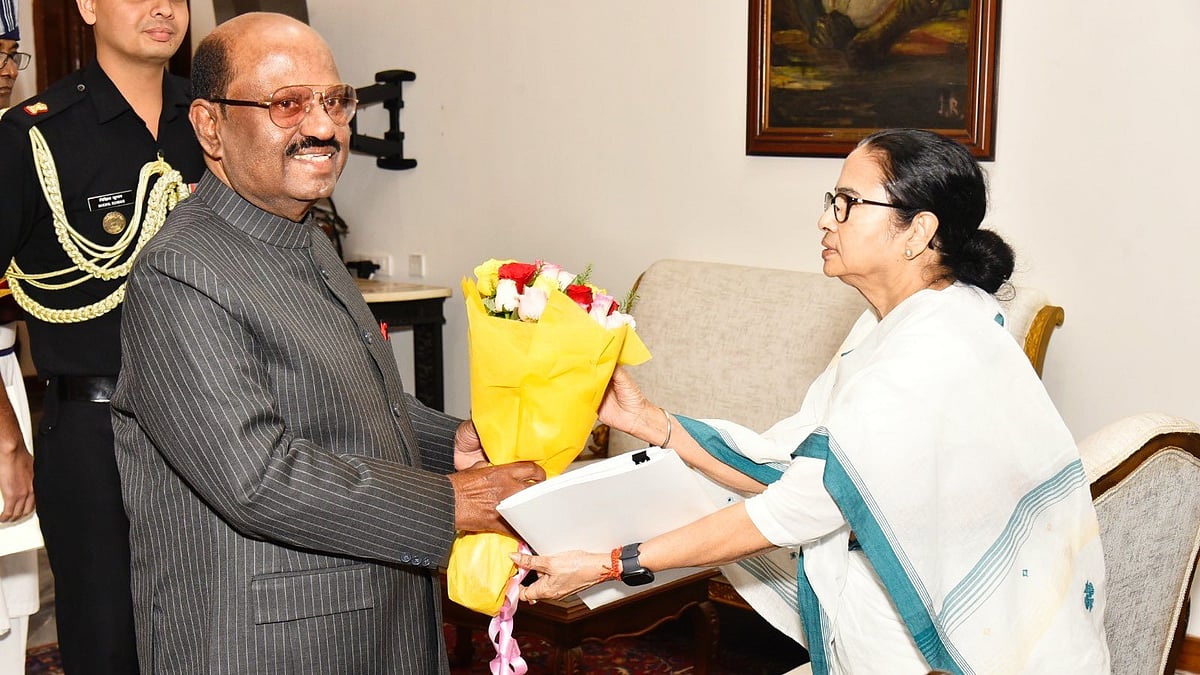
It is against this background that state ministers and AITC leaders have voiced apprehensions of a diabolical plan to delay the election and impose President’s Rule in West Bengal. Their doubts turned into near conviction on the evening of Thursday, 5 March, when governor C.V. Ananda Bose abruptly resigned.
A shocked chief minister Mamata Banerjee took to X to say, “I would not be surprised if the Governor has been subjected to some pressure from the union home minister to serve certain political interests on the eve of the forthcoming State Assembly elections.”
Bose had 20 more months left of his five-year term. He had got himself registered as a voter in West Bengal barely six days ago and on Friday, 6 March, was to be in Darjeeling to receive the President of India. He was clearly summoned to Rashtrapati Bhavan and advised to resign. Even while he was there, the news was leaked to the media. Questioned by the media, all he could say was that he had been a governor for nearly three-and-a-half years and that for him was quite enough.
Bose was not particularly popular. His tenure was marked by several controversies including one involving a sexual harassment allegation by an employee of the then Raj Bhavan, now renamed Lok Bhavan. He had also followed in the footsteps of his illustrious predecessor Jagdeep Dhankhar who, as governor, interfered with the administration of the state. BJP leaders in the state were, however, unhappy with Bose, who they felt was not quite hard enough on the ruling party.
It is his successor, former Tamil Nadu governor R.N. Ravi, who has triggered the suspicion that the Centre is getting ready for a spell of President’s Rule in the state.
Ravi — a former IPS officer who was in the Intelligence Bureau and a deputy national security adviser under Ajit Doval — has had a running duel with Tamil Nadu chief minister M.K. Stalin for the last four years. Earlier, he had to be removed as Nagaland governor and as the Centre’s interlocutor with Naga insurgent groups because of his ‘style’ in 2021.
With the Supreme Court frowning on his conduct in sitting over legislations for an inordinately long time last year, former editor of The Hindu N. Ram had this to say about him: “Today, there is a total attack on the concept of federalism. A governor is the instrument. If we take a list of the worst governors in the history of independent India, R.N. Ravi would be in the top three.”
However, Ravi is New Delhi’s blue-eyed boy, ideologically close to the nationalistic and religious ideology of the Sangh Parivar. With a mercurial chief minister in the saddle, the next few weeks in West Bengal promise to be combative and dramatic. For now, all eyes are set on the visit of the election commissioners.
Join our official telegram channel (@nationalherald) and stay updated with the latest headlines