


Why In(didn’t)Go and we didn’t see
Alarm bells should have gone off in first fortnight of Nov, when average cancellations went up from around 14 flights a day to 40
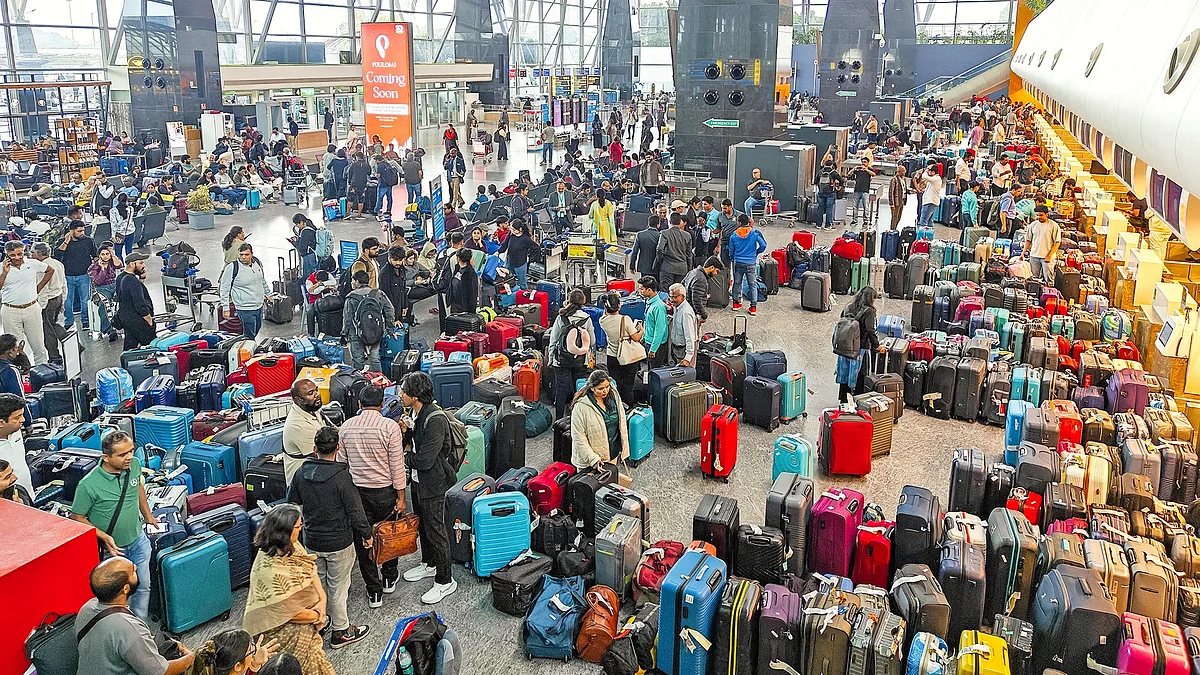


In hindsight, the IndiGo meltdown was a nightmare waiting to happen. Alarm bells should have gone off in the first fortnight of November, when average cancellations went up from around 14 flights a day to 40. The numbers kept climbing until the entire system collapsed and, on a single day in December, over a thousand flights were cancelled.
Thousands of passengers were left stranded at airports, with no clarity on when they would be able to fly. Domestic passengers missed job interviews, weddings, funerals, hospital appointments and international connections. Foreign nationals missed their return flights.
In Pune, passengers had to wait inside the plane after landing because the pilot could not find a place to park. All parking bays were occupied by IndiGo aircraft. Passengers on a Patna-Delhi flight found themselves stranded in Bhubaneswar after their direct flight was cancelled. As ticket prices on other airlines soared, the government dragged its feet.
On 6 December, the ministry of civil aviation and the Directorate General of Civil Aviation (DGCA) ordered the capping of fares. John Brittas, Rajya Sabha MP, was quick to point out that the government had always claimed it could not intervene: there was no predatory pricing, airfares are demand-driven and no cartels exist. Had the government lied when it claimed to be helpless?
After failing to prevent the fiasco, the DGCA swung into damage control mode. On 9 December, it ordered IndiGo to curtail daily flights by 10 per cent, served a show-cause notice to the airline’s board and deputised officials to IndiGo offices and airports. It was a classic case of shutting the stable door after the horse has bolted.
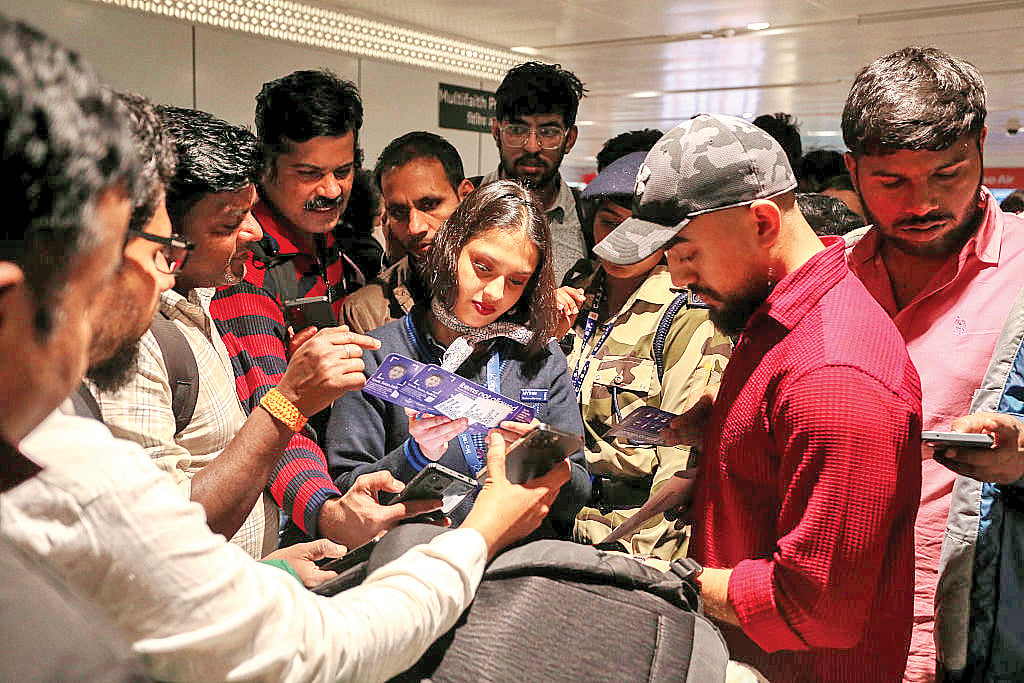
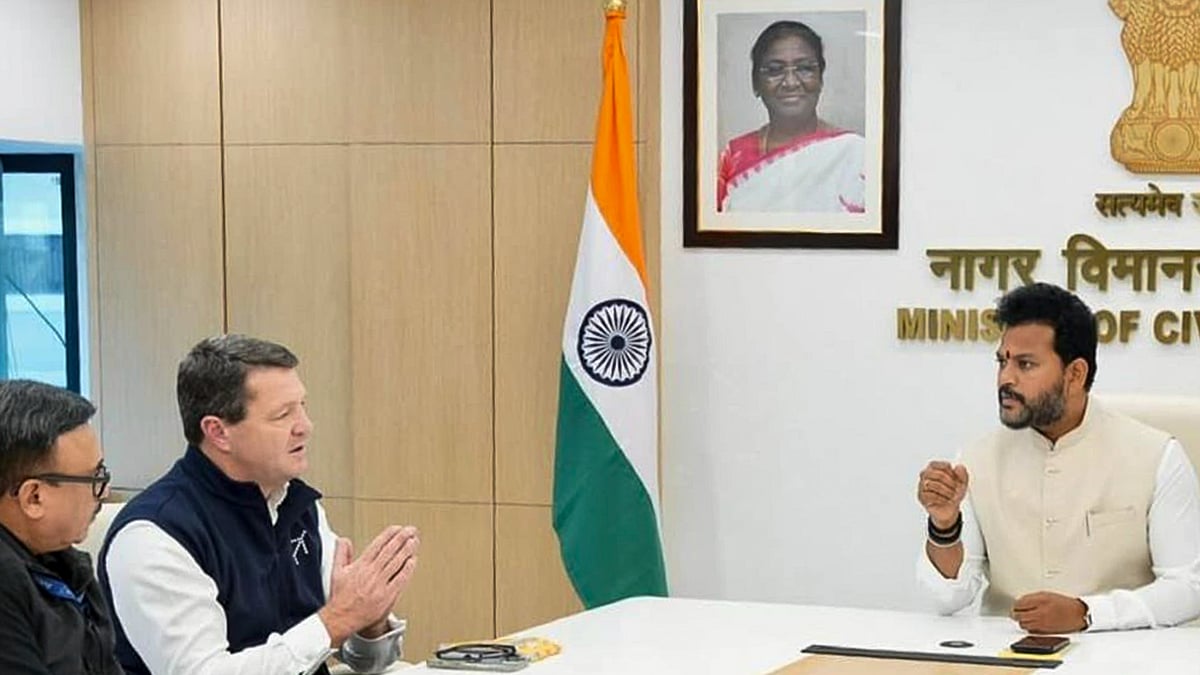
The ministry even released a photograph of Dutch CEO Pieter Elbers at a meeting with Union aviation minister Ram Mohan Naidu Kinjarapu. Elbers’s gesture of hands folded in a ‘namaste’ was read as apology or supplication to the powers that be.
Nothing can fully explain the collapse of one of the more profitable airlines in India, which posted a net profit of Rs 7,500 crore in 2023–24, operated a fleet of 400 aircraft (double Air India’s) and ran as many as 2,200 flights a day. Significantly, Air India, which operates fewer flights, has more pilots — 6,350 as opposed to IndiGo’s 5,085. The DGCA knew all this but still allowed IndiGo to fly. It even approved an increase in the number of flights, especially night flights sought by the airline for the peak winter holiday season.
Carefully planted reports in the media suggest that the DGCA is demanding that heads roll. Some aviation experts suggest that the mop-up should start not with IndiGo but with the DGCA itself. To be fair, the directorate continues to work under the shadow of the civil aviation ministry and is not autonomous. The buck, therefore, should stop at the government’s door.
The DGCA and ministry of civil aviation’s response to the crisis reflects regulatory weakness. Instead of enforcing fatigue norms strictly, the DGCA quickly rolled back some of the Flight Duty Time Limitations (FDTL) rules under pressure to avoid further flight cancellations. This regulatory backtracking sent a troubling message to the industry: cause enough disruption and safety regulations will be diluted. A logic that extends to the ministry of corporate affairs when it comes to overlooking persistent red flags.
****
“When airlines push the limits, the regulator is supposed to push back. But what happens when the DGCA approves every weak process, signs off every shortcut and trusts the very systems that keep failing?” asks an aviation expert.
The IndiGo meltdown was no accident. It was proof that the regulator, instead of being in the driver’s seat, had become a passenger, rubber-stamping whatever the operators wanted. When that happens, air safety becomes a matter of luck, not rule nor rigour.
For years, India’s airlines bucked international FDTL standards — rules that determine how long pilots can fly, how much rest they must get between duties and how many night landings they can undertake. These norms are based on global standards laid down by the International Civil Aviation Organisation (ICAO), the US-based Federal Aviation Administration (FAA) and the European Union Aviation Safety Agency (EASA), backed by decades of research on human performance under fatigue. The norms were ignored for far too long until the pilots pushed back and courts intervened.
Finally, in 2024, the DGCA decided to align Indian norms with international practice. The principle was simple: more rest, fewer night landings, clearer limits. The decision was grounded in science and overdue by years, perhaps decades. Scientific studies showed that long hours without adequate rest posed significant safety risks by impairing the pilots’ cognitive performance, alertness and reaction time.
This is particularly crucial during night duty and the circadian low period between 2.00 am and 6.00 am, when fatigue peaks due to irregular schedules and sleep deprivation.
The DGCA addressed this through revised FDTL norms, announced in January 2024 and implemented over two phases in July and November this year. The new rules extended the weekly rest period of pilots to 48 consecutive hours, redefined night duty as 00:00–06:00 (12.00 am to 6.00 am) and capped night landings to two per shift, down from six. The new rules also restricted consecutive night duties to two.
Shockingly, IndiGo failed to take the steps necessary to comply with the revised safety-focused FDTL rules introduced to combat pilot fatigue. Rather than investing in increasing pilot strength and standby pools, IndiGo imposed a freeze on hiring, froze pay scales, reduced earned leave allowed to pilots and pushed crew members to legal duty limits without buffers for contingencies.
Reports suggest that it also counted ‘deadhead’ periods (flights that pilots take as passengers before getting into the cockpit for the next flight) as ‘rest’. The DGCA could not have been ignorant of these developments. Yet it did nothing.
Air India, on the other hand, cut its operations from about 5,600 weekly flights across 90 domestic and international routes with 208 aircraft to roughly 4,700 weekly flights across 82 destinations with a fleet of 187 aircraft by November 2025. With adequate pilot availability, a lighter roster and better planning, Air India switched to the new FDTL rules smoothly. As a result, even as IndiGo hit turbulence last week, Air India continued to operate largely without disruption.
IndiGo persisted in flying its aircraft at maximum utilisation rates of 12–13 hours per day, among the highest globally for short-haul operations, ramping up night rotations for their superior commercial returns and rostering crews right up to the legally fixed fatigue margins with minimal buffers.
This lean model, which maximised revenue through tight schedules and heavy reliance on late-night and early-morning ‘red-eye’ flights, left little slack when DGCA’s revised FDTL norms kicked in fully on 1 November 2025, capping night landings and extending rest requirements.
As a senior captain observed, “We were running at 100 per cent. Any shock was bound to break something.”
How and why were the DGCA and the IndiGo board not bothered about passenger safety being compromised? The SEBI and the ministry of corporate affairs were also reluctant to act decisively on governance concerns highlighted by IndiGo co-founder Rakesh Gangwal years ago. Such regulatory inertia raises the question: who is regulating whom?
****
To understand the real cause behind IndiGo’s collapse, one must revisit a warning issued by Rakesh Gangwal way back in 2019. Gangwal was an aviation veteran with almost four decades of industry experience, including senior positions at United Airlines and as CEO of US Airways.
When IndiGo was founded in 2006, it was Gangwal who was credited with setting up the airline’s disciplined, low-cost operational model, securing massive aircraft orders and building a lean cost structure that made IndiGo a case study in efficiency.
But in July 2019, Gangwal made a public complaint to SEBI about serious governance lapses at IndiGo. His complaint focused on the disproportionate control wielded by co-founder Rahul Bhatia — a Delhi-based businessman — and his InterGlobe Enterprises (IGE) group, which held rights to appoint five out of 10 directors on the board, as well as the MD, CEO and President, while Gangwal could appoint only one.
Gangwal’s grouse was that this power skew resulted in a board that lacked genuine independence. It could not properly challenge management decisions or related-party transactions involving other Bhatia-linked companies like InterGlobe Hotels and InterGlobe Real Estate ventures.
Gangwal’s scathing critique likened the governance of IndiGo to a ‘paan ki dukaan’ — a betel leaf shop with no formal accountability. He warned that such concentrated control created a blind spot to risk and compromised the institutional durability of IndiGo.
Despite subsequent arbitration and some tweaking of shareholder agreements, after a tribunal in London ruled in Gangwal’s favour, Bhatia managed to retain overwhelming control. Gangwal quit IndiGo in February 2022. Since then, he is said to have systematically sold off a 37 per cent stake in the airline, retaining just five per cent by mid-2025. The shares sold by Gangwal are estimated to be valued at over Rs 45,000 crore.
Experts blame the government for promoting a virtual duopoly of the civil aviation market with just two airlines — IndiGo (60–65 per cent) and Air India (20–23 per cent) — cornering over 80 per cent of the market.
The DGCA also failed to control IndiGo from abusing its dominant position to browbeat smaller airlines, cloning their routes to knock them out of competition and undercutting rivals through aggressive pricing. Worse, it was then allowed to withdraw from many of these ‘unprofitable’ sectors covering, say, the Northeastern states.
IndiGo’s collapse is a grim case study in how corporate arrogance, regulatory procrastination and governance failures combined to imperil millions of consumers’ trust and safety. The time for cosmetic measures is over. India’s aviation industry demands bold accountability and structural reforms, before the next crisis strikes.
Join our official telegram channel (@nationalherald) and stay updated with the latest headlines