World
Explained: Tactical anatomy of Israel–US strike on Iran and Tehran’s counteroffensive
The Middle East has entered a new, volatile strategic phase — one shaped not by shadow operations, but by open confrontation
Today, on 28 February 2026, Israel launched Operation Roaring Lion (Mivtsa She’agat Ha’Ari), its largest overt military campaign ever conducted against Iran.
While some media reports referenced an alternate symbolic phrase — Shield of Judah (Magen Yehuda) — invoking biblical imagery of protection, Israeli official communications identify Roaring Lion as the primary operational name to tone down the religious undertones in the decades-old conflict. The United States participated under a separate Pentagon designation — Operation Epic Fury — covering American air, naval and missile components.
Within hours, Iran retaliated in an operated codenamed Operation True Promise 4, launching a massive missile and drone barrage targeting Israel and US military facilities across Kuwait, UAE, Bahrain, Turkey and Saudi Arabia. This confrontation marks a decisive shift from covert shadow conflict into open, coordinated state-on-state warfare.
Strategic trigger: Nuclear threshold and escalation logic
The strikes followed intelligence assessments that Iran had accumulated uranium enriched beyond 90 percent — near weapons-grade level — at sites including Fordow and Natanz. Israel has long stated it would not permit Iran to cross what it calls the “nuclear threshold.”
Diplomatic negotiations between Washington and Tehran had stalled. The US administration framed the operation as an effort to permanently degrade Iran’s ability to produce nuclear weapons and long-range missiles.
Strategically, the campaign appears designed to:
Recede nuclear enrichment capacity
Destroy missile production and storage sites
Disrupt IRGC command-and-control (C2) nodes
Restore deterrence through overwhelming force
Unlike earlier limited strikes, Roaring Lion was structured as a sustained degradation campaign rather than a single raid.
Phase 1: Blinding Iran’s air defences
The opening phase focused on SEAD (Suppression of Enemy Air Defenses) — neutralising radar and missile systems before deep penetration.
Iran’s air defence network includes:
S-300PMU2 (Russia)
S-400 Triumf (Russia)
Bavar-373 (Iran)
Rezonans-NE radar system (Russia)
To counter them, Israel deployed F-35I “Adir” stealth fighters (United States origin, modified for Israel) equipped with Israeli Scorpius electronic warfare pods. The United States contributed EA-18G Growler electronic attack aircraft (United States). However, it is yet not confirmed if western military hardware was able to jam S-400 Triumf which is touted as the world's best air defence system till date.
Radar-seeking munitions used included:
AGM-88 HARM anti-radiation missile (United States)
HAROP loitering munition (Israel)
These systems jam radar frequencies or destroy emitters once activated, opening corridors for follow-on strikes.
Phase 2: Strikes on missile infrastructure
Once air defences were degraded, stealth and long-range strike platforms targeted hardened facilities.
Key weapons employed:
Spice-2000 precision-guided bomb (Israel)
Rampage air-launched missile (Israel)
GBU-57 Massive Ordnance Penetrator (United States) — 30,000-lb bunker buster
Tomahawk Block V cruise missile (United States)
The GBU-57, delivered by B-2 Spirit stealth bombers (United States), is specifically engineered to penetrate deeply buried bunkers such as those protecting Fordow.
US Navy destroyers launched Tomahawks from the Arabian Sea. Israeli Dolphin-class submarines (Germany-built for Israel) reportedly operated in deterrence posture.
Over 500 strike sorties were conducted in the initial wave, according to international defence reporting.
US Navy's pivotal role
The US Navy’s contribution to Operation Epic Fury was central to both the offensive reach and defensive resilience of the broader Israel–US campaign.
Forward-deployed carrier strike groups in the Arabian Sea and Gulf provided sustained airpower without relying exclusively on regional land bases.
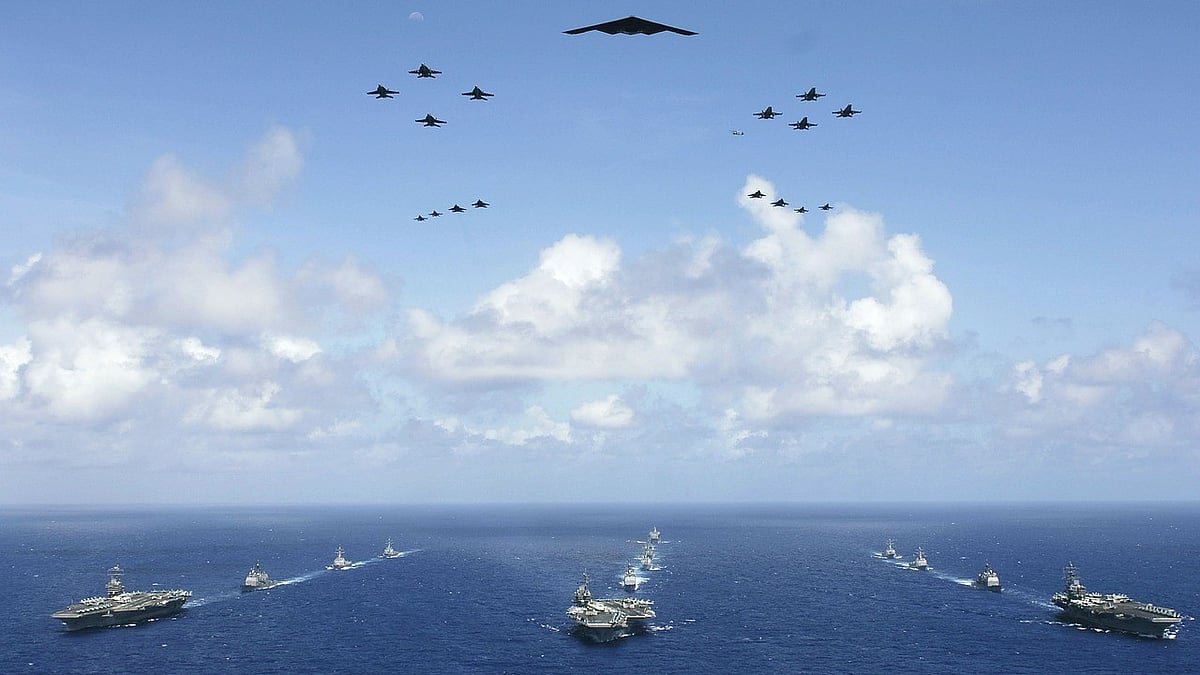
Among the carriers reported in theatre were USS Gerald R. Ford (CVN-78), USS Dwight D. Eisenhower (CVN-69), USS Harry S. Truman (CVN-75) and USS Abraham Lincoln (CVN-72).
From their decks, more than 200 F/A-18E/F Super Hornet multirole fighters (United States) conducted alpha strike missions targeting IRGC coastal installations and missile infrastructure.
Airborne early warning aircraft — E-2D Advanced Hawkeye — coordinated intercept patterns and managed airspace control, particularly against Iranian drone swarms launched during Operation True Promise 4.
Surface escorts expanded the strike envelope. Ticonderoga-class guided missile cruisers such as USS Gettysburg and USS San Jacinto deployed Vertical Launch Systems (VLS) to fire large salvos of Tomahawk Block V cruise missiles.
These sea-launched precision weapons reportedly targeted radar arrays, operating inside Iran, helping degrade integrated air defence networks early in the campaign.
Meanwhile, Arleigh Burke-class destroyers — including USS Stout and USS Roosevelt — activated the Aegis Ballistic Missile Defense system. Using SM-3 and SM-6 interceptors, they engaged incoming ballistic threats during Iran’s retaliatory missile waves, reportedly neutralising a significant portion of projectiles headed toward Israel and US Gulf installations.
Subsurface assets added another layer of pressure.
Virginia-class and Ohio-class nuclear-powered submarines are believed to have launched covert Tomahawk barrages against Iranian naval facilities in Bandar Abbas. The expeditionary sea base USS Lewis B. Puller (ESB-3) supported special operations helicopters and maritime security missions.
Strategically, this naval posture enabled continuous 24/7 sortie generation, protected Gulf shipping lanes, and neutralised Iranian naval capabilities early — conditions that made sustained daylight strike operations against Tehran feasible without exposing Israeli aerial refuelling aircraft to disproportionate risk.
Iran’s response: Operation True Promise 4
Within hours, Iran’s Islamic Revolutionary Guard Corps (IRGC) Aerospace Force launched retaliatory waves of missiles and drones.
Iran deployed:
Emad ballistic missile (Iran)
Qiam-2 ballistic missile (Iran)
Fateh-110 / Fateh-313 short-range ballistic missiles (Iran)
Shahed-136 and Shahed-238 drones (Iran)
Ballistic missiles travel at hypersonic speeds (Mach 5+), making interception complex.
Targets included Tel Aviv, Nevatim Air Base, and US facilities such as Al Udeid (Qatar) and Al Dhafra (UAE).
Israel and the US activated layered missile defence systems:
Iron Dome (Israel) – short-range intercept
David’s Sling (Israel) – medium-range defence
Arrow-2 and Arrow-3 (Israel/United States joint system) – ballistic missile defence
Patriot and THAAD systems (United States)
Officials reported interception rates between 85–95 percent, though impacts occurred in central Israel.
Casualties and Escalation Dynamics
Preliminary assessments indicate:
200+ fatalities reported inside Iran, including IRGC personnel and nuclear-linked figures
Limited civilian injuries reported in Israel
No confirmed US fatalities so far
Oil prices surged sharply amid fears of Strait of Hormuz disruption. Gulf airspace closures disrupted global aviation.
Iran’s doctrine appears to favour prolonged asymmetric missile pressure rather than immediate ground escalation. Israel’s strategy appears aimed at decisive nuclear rollback.
Strategic outlook
Roaring Lion and Epic Fury represent the most significant direct Israeli-US military engagement against Iran in modern history.
The confrontation now carries three major risks:
Expansion into multi-front proxy war (Hezbollah, Houthis)
Sustained missile exchange cycles
Economic shock via energy market disruption
The transition from covert confrontation to overt military engagement fundamentally alters regional deterrence dynamics.
Whether this leads to negotiated de-escalation or a prolonged regional war will depend on the next operational cycle.
The Middle East has entered a new, volatile strategic phase — one shaped not by shadow operations, but by open confrontation.
Join our official telegram channel (@nationalherald) and stay updated with the latest headlines