World
From school gates to street clashes: France erupts in student protests
Unrest that began in Paris suburbs spreads nationwide, with police using tear gas and making mass arrests
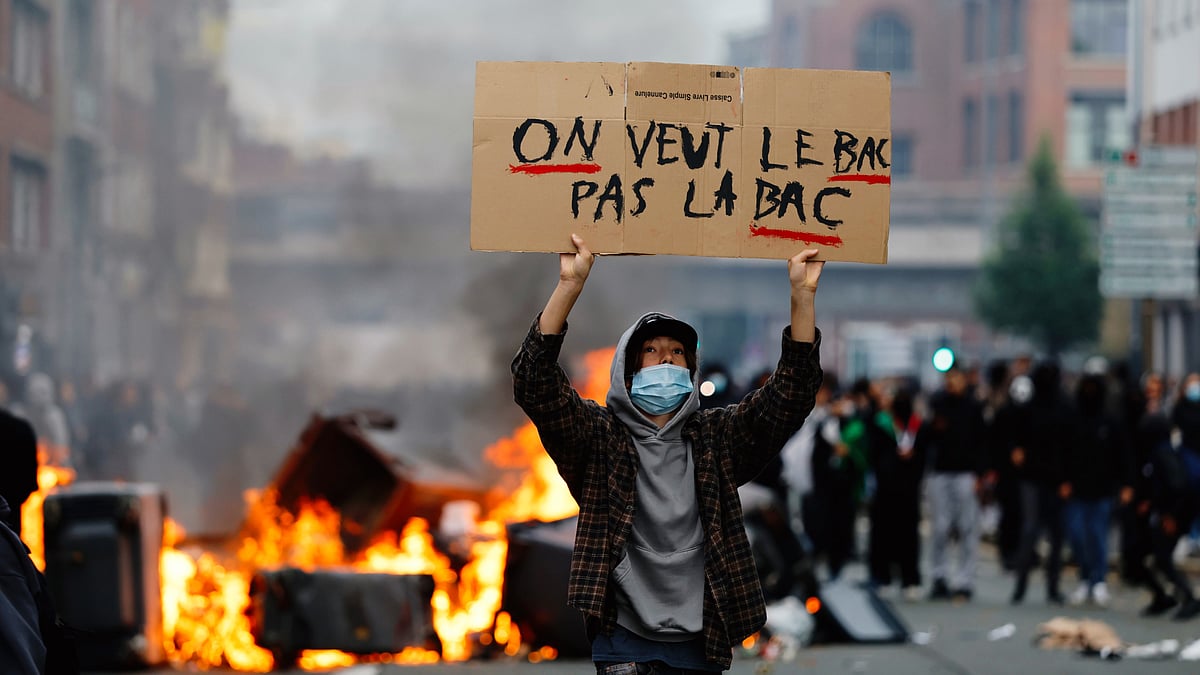
Student protests that began in the Paris region have spread across France, affecting 560 schools and leading to more than 1,900 arrests on Thursday alone.
High school students are protesting school conditions, staffing and the university admissions system, while clashes with police have escalated.
The unrest has become a political flashpoint ahead of France’s May presidential election, with candidates taking sharply different positions.
Thousands of arrests, hundreds of injuries and schools set on fire — France’s new academic year has descended into nationwide student protests and unrest barely a month after classes resumed.
In a country already beset by domestic and international crises, the eruption and rapid spread of protests by disgruntled high school students has caught the government off guard.
Friday, 2 October brought more of the scenes that have dominated French streets this week: vandalism, burning rubbish, teenagers confronting and taunting police, and officers charging crowds, firing tear gas and making arrests. By early afternoon, the education ministry said protests had affected 560 schools.
Taking grievances to the streets has long been a feature of French political life, from the student protests of 1968 and suburban unrest in 2005 to the mass demonstrations against pension reforms in 2023. The students now barricading school gates and carrying placards have displayed some of the same street-protest know-how, including wearing masks and goggles to protect themselves from tear gas.
What sets the current protests apart is their timing. France is heading towards a presidential election next May, and candidates seeking to succeed President Emmanuel Macron have seized on the unrest as a political issue.
Macron, who is constitutionally barred from seeking a third consecutive term, has also weighed in, condemning violence while warning against political manipulation of young protesters.
Protests began in the Paris region
The protests erupted last week in the Paris region before spreading rapidly across the country, including to smaller towns.
High school students have raised a range of grievances, chiefly over under-resourced schools, dilapidated facilities and inadequate staffing. Yet education remains one of the largest items in the state budget proposed by Macron’s government this week, with 65.5 billion euros (USD 74 billion) earmarked for schools next year — more than the 63.4 billion euros proposed for defence.
Students also complain that school days, which often begin at 8 am, are exhausting and that the university admissions system is overly complicated. Some university students have joined the demonstrations.
Government says protests have turned violent
Macron’s government has repeatedly said it respects the right to peaceful protest. But it has also ordered police to clear demonstrations blocking access to schools and move quickly against violence and vandalism.
Riot police have used tear gas and batons and made large numbers of arrests. Police and school staff have been targeted with fireworks and other projectiles. The interior ministry said acid had also been thrown in some incidents.
The ministry has accused people intent on destruction and looting of attaching themselves to the student movement and behaving as "criminals and vandals" rather than "young people legitimately voicing their demands".
Police made more than 1,900 arrests on Thursday, 1 October, when 305 officers were injured, according to the interior ministry. The confrontations continued on Friday, while unrest also spread to neighbouring Belgium, where about a dozen schools in Liege closed a day after violence in the city led to six arrests.
Protests reflect wider concerns over French schools
The unrest comes amid broader concerns that France’s education system is falling behind other countries and failing to provide enough social mobility for children from disadvantaged backgrounds.
The latest PISA assessment found widening performance gaps between highly advantaged and disadvantaged students, while overall French scores in reading comprehension and mathematics have fallen.
The government also banned smartphones from high schools when the academic year began in September, arguing that removing screens would improve learning. France had also moved to become the first European Union country to ban social media platforms for children under 15, but the country’s top court struck down the measure.
Election campaign adds another dimension
The unrest is sharpening political divisions as parties position themselves ahead of next year’s presidential election.
Far-left leader Jean-Luc Mélenchon has strongly backed the students and condemned police action as "savagery" and repression. Police have faced scrutiny over the use of crowd-control projectiles in some incidents in which protesters were injured.
Mélenchon’s critics, meanwhile, have accused his France Unbowed party of encouraging violence and exploiting the protests for political gain.
Far-right leader Marine Le Pen has called for broader police powers to deal with rioters. Conservative former prime minister Edouard Philippe, one of her potential rivals in the presidential race, has condemned those who "break things, burn things, or assault people".
With AP/PTI inputs
Join our official telegram channel (@nationalherald) and stay updated with the latest headlines