World
Trump, top Iranian official exchange threats over protests now roiling Iran
Economic unrest spreads beyond Tehran as deadly clashes mount and Washington–Tehran rhetoric sharply escalates
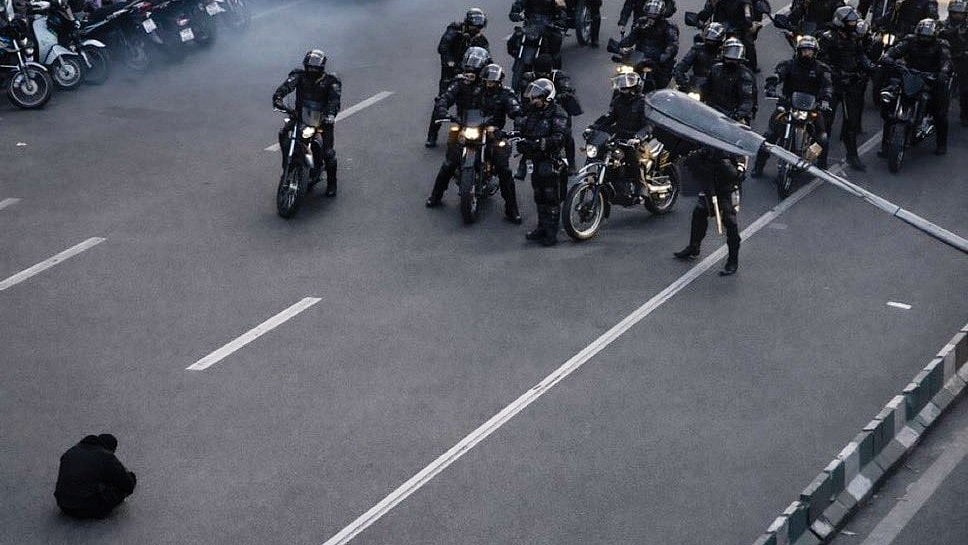
Widening economic protests in Iran entered their sixth day on Friday, spreading from urban centres into rural provinces and prompting a sharp exchange of threats between US President Donald Trump and a senior Iranian security official, as the Islamic Republic signalled it may be preparing a tougher response.
At least six to seven people have been killed so far in violence linked to the demonstrations, according to a mix of Iranian and international reports, marking the first confirmed fatalities among both protesters and security personnel. The unrest, triggered by Iran’s collapsing currency and rising prices, has become the country’s largest wave of protests since 2022, when the death of Mahsa Amini in police custody sparked nationwide demonstrations.
On Friday, Trump weighed in publicly, warning Tehran against the use of force. Writing on his Truth Social platform, the US president said if Iran “violently kills peaceful protesters,” the United States “will come to their rescue.”
“We are locked and loaded and ready to go,” Trump added, without specifying what action Washington might take.
Iran swiftly pushed back. Ali Larijani, a former parliamentary speaker who now serves as secretary of Iran’s Supreme National Security Council, accused the United States and Israel of stoking the protests — a charge Iranian authorities have frequently made during past waves of unrest, though without offering evidence.
“Trump should know that intervention by the US in the domestic problem corresponds to chaos in the entire region and the destruction of US interests,” Larijani wrote on X, a platform banned in Iran. He warned Americans to “take care of their own soldiers,” an apparent reference to the US military’s extensive presence across West Asia.
The warning came with recent precedent in mind. In June 2025, Iran launched missiles at the Al Udeid Air Base in Qatar following US strikes on three Iranian nuclear sites during Israel’s 12-day war with the Islamic Republic.
While demonstrations in Tehran appeared to slow, unrest spread into Iran’s western and south-western provinces, particularly areas with large Lur populations. The most intense violence was reported in Azna, in Lorestan province, about 300 km southwest of the capital, where online videos showed fires in the streets and gunfire echoing as crowds shouted 'Shameless! Shameless!'
Iran’s semiofficial Fars news agency reported three deaths in Azna, though state media largely avoided detailed coverage. During the 2022 protests, journalists faced arrest for reporting on unrest, a factor that may be limiting on-the-ground information.
In Lordegan, in Chaharmahal and Bakhtiari province, videos showed demonstrators gathered amid the sound of gunfire. Fars cited an anonymous official saying two people were killed there, while the Washington-based Abdorrahman Boroumand Center for Human Rights in Iran identified two demonstrators as having died.
A separate protest in Kouhdasht, also in Lorestan province, reportedly led to the death of a 21-year-old volunteer member of the Basij paramilitary force. State-run IRNA confirmed the death but offered no details, while outlets close to the Basij blamed protesters and said at least 13 security personnel were injured.
Local officials described the unrest as driven by economic distress. “The protests that have occurred are due to economic pressures, inflation and currency fluctuations,” said Saeed Pourali, a deputy governor in Lorestan. He said authorities would listen to grievances but warned against what he called “profit-seeking individuals” exploiting the situation.
Iran’s reformist President Masoud Pezeshkian has attempted to signal openness to dialogue with protesters. However, he has publicly acknowledged his limited room for manoeuvre as the rial continues to slide, with the US dollar now trading at around 1.4 million rials on the open market — the immediate trigger for the demonstrations.
State television reported the arrest of several people accused of links to monarchist or Europe-based opposition groups, as well as the seizure of smuggled weapons, though details were scarce. Authorities also declared a public holiday across much of the country midweek, officially citing cold weather — a move widely seen as an effort to thin crowds in major cities.
While rooted in economic hardship, the protests have increasingly included chants against Iran’s theocratic system itself, echoing earlier movements.
The unrest is unfolding against a volatile regional backdrop. Iran’s leadership is still reeling from June’s brief but intense war with Israel, during which the US joined strikes on Iranian nuclear facilities.
Since then, Tehran has said it is no longer enriching uranium at any site in the country, signalling continued interest in negotiations to ease sanctions. However, talks have yet to resume, with Trump and Israeli Prime Minister Benjamin Netanyahu both warning Iran against rebuilding its nuclear programme.
As protests widen and rhetoric sharpens, Iran now faces pressure on multiple fronts — from its streets, its economy, and an increasingly hostile international environment.
With AP/PTI inputs
Join our official telegram channel (@nationalherald) and stay updated with the latest headlines