Nation
Anti-Christian violence and ‘anti-conversion’ laws make it a season of grim reflection
Christian minority of around 32 million faces rising fear of violence from RSS-linked Hindu extremist groups
In its bid to deflect Washington’s tariff push on a wide range of European products, the European Union (EU) is showing renewed keenness to conclude the protracted Free Trade Agreement (FTA) with India, which officially began in 2007, even overlooking its repeated censure of New Delhi for the “escalating violence and discrimination faced by Christian communities” across the country.
Under the Treaty on European Union of 1993, the EU has included clauses in its international agreements prescribing ‘appropriate measures’ against a party, including suspension of an agreement, if it fails to uphold human rights and democratic principles.
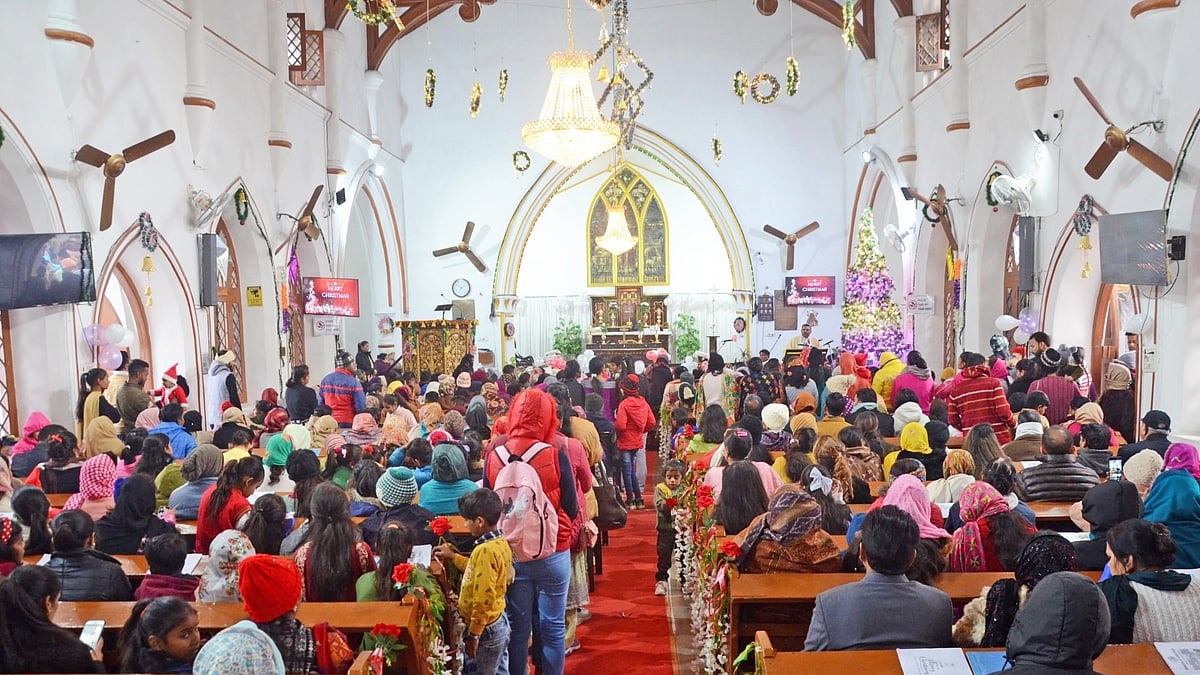
Church leaders in India caution vigilance to the community particularly around Christmas, and petition authorities for stronger protection and action against perpetrators.
Days after a visiting high-level EU delegation conferred with Indian counterparts over a week in November, Members of the European Parliament and human rights advocates participated in a meeting on Targeted Violence against Christians in South Asia organised at the European Parliament (EP) in Brussels on 4 December by the Christian legal advocacy group, ADF (Alliance Defending Freedom) International.
Participants expressed concern that ever since India’s Hindu majoritarian Bharatiya Janata Party (BJP) government came to power in 2014, attacks on minorities – Muslims, Christians and Dalits - have been widespread and systematic.
This year too, as it celebrates the Christmas season, the Christian minority – estimated at around 32 million, or 2.2 per cent of the overall 1.46 billion population – is apprehensive about anti-Christian violence and rhetoric by RSS-affiliated Hindu extremist groups like Bajrang Dal, Vishva Hindu Parishad (VHP) and Hindu Mahasabha.
Hindu vigilantes routinely deem Christmas festivities as provocations to attack churches and Christians, including priests and nuns, disrupt congregations, destroy property, and storm schools to tear down Christmas decorations, vandalise classrooms and terrify teachers and pupils found celebrating.
The EU has been particularly alarmed by the ethnic violence raging in Manipur since 2023 between the majority Hindu Meitei tribals and the minority Christian Kukis. Over 250 people have lost their lives, a thousand others wounded, some 67,000 displaced, and hundreds of churches and thousands of homes ransacked and destroyed. Many women have been raped before being murdered.
A sharply worded resolution that year by the EP exhorted “the Indian authorities to take all necessary measures …… to protect all religious minorities, such as Manipur’s Christian community, and to pre-empt any further escalation”. It denounced “in the strongest terms the nationalistic rhetoric deployed by leading members of the BJP party”, underscoring “concerns about politically motivated divisive policies that promote Hindu majoritarianism in the area”.
The Brussels meeting briefed policymakers on the urgent need for stronger EU engagement on freedom of religion or belief. Participants pointed to the United Christians Forum’s documentation of incidents of violence, including mob assaults, public humiliation, church disruption, and demolitions of homes. The Forum reported a sharp increase in attacks against Christians across India, rising from 127 cases in 2014 to 834 in 2024, averaging more than two attacks per day.
The speakers in Brussels noted that 12 Indian states now enforce anti-conversion laws that are often used to intimidate and criminalise peaceful religious activity. This year, 123 criminal complaints have been filed against Christians, and several believers remain in prison across the country.
“Christians in India are punished not for wrongdoing, but for simply gathering, praying or helping their neighbours,” explained ADF International’s Tehmina Arora. “Even the Supreme Court of India recently noted how the anti-conversion laws are misused to wrongly prosecute Christians.”
Quashing all criminal proceedings against Christians in October, a Supreme Court bench of Justices J.B. Pardiwala and Manoj Misra delivered a scathing rebuke to authorities, observing, “The criminal law cannot be allowed to be made a tool of harassment of innocent persons, allowing prosecuting agencies to initiate prosecution at their whims and fancy, on the basis of completely incredulous material.”
The judgment quashed all FIRs, along with all consequential proceedings, vindicating Evangelical Church of India Pastor Vijay Masih and staff members of Broadwell Christian Hospital in Fatehpur, officials of Sam Higginbottom University in Prayagraj, and others named since 2022 under Uttar Pradesh’s anti-conversion law.
The vindication followed the acquittal in neighbouring Uttarakhand of the first Christian charged under its “anti-conversion” law, with Pastor Nandan Singh cleared after a four-year battle.
During his official India visit in July, Vatican foreign minister Archbishop Paul Richard Gallagher met his Indian counterpart, S. Jaishankar, for what was described as a “good conversation about the importance of faith, and the need for dialogue and diplomacy”.
A year earlier, a delegation of the Catholic Bishops’ Conference of India met Prime Minister Narendra Modi to express concern over mounting anti-Christian violence and the misuse of anti-conversion laws, seeking his intervention to stop such hate crimes.
Church leaders believe that if conversion was indeed taking place as widely as alleged, India’s Christian population would have risen dramatically, whereas the community has routinely comprised but 2 per cent to 3 per cent of India's population in every census since 1951. They feel that if there was sufficient proof, the accusers could always approach the courts, instead of taking the law into their own hands.
Videos have surfaced on social media showing Hindutva activists brutalising principals of schools that have pupils reciting Christian prayers. Mobs at times also parade effigies of Santa Claus that they thrash with chappals (sandals) in a Hindu act of humiliation, and set aflame, as happens especially in north India.
Goons systematically raid homes of people they brand as Christian converts, thrashing them and seizing all religious items like Bibles, crosses, Christ idols and rosaries. They abuse and force the victims to profane Christianity and to chant Hindu prayers instead, while pledging to be forever Hindus. In Jharkhand, BJP leader Gunjan Yadav, accompanied by a mob, led a raid on a Christian family’s home last July, accusing them of conducting religious conversions. Acting on their complaint, local police detained 12 individuals and seized Bibles and other religious material as “evidence”.
Reports also indicate a climate of impunity where perpetrators often face little to no formal police action.
On 22 March, three platoons of police reportedly barged into a Catholic Church in Odisha’s Berhampur diocese, assaulting minor girls cleaning the premises and two priests, even abusing and robbing under false accusations of forced religious conversion. A fact-finding team from the Odisha Lawyers Forum of Religious and Priests Advocates documented the violations and filed complaints, but indicated that instead of acting on their complaint, authorities labelled the victims as disturbers of peace.
Metropolitan India has been generally more tolerant, with Mumbai’s significant Christian population, of East Indians, Koli Christians and others with historical roots, largely unthreatened. Christians, however, protested in large numbers in Mumbai against BJP MLA Gopichand Padalkar after he had, in a public address in Sangli on 17 June, allegedly offered a Rs3 lakh to Rs11 lakh bounty for acts of violence against Christian priests and missionaries engaging in “forceful conversions”. Similar protests were held in several cities and districts across Maharashtra with demands for Padalkar’s resignation and an FIR against him.
Around the same time, the Archdiocese of Bombay expressed “deep concern” over state revenue minister Chandrashekhar Bawankule’s proposal to enact a strict anti-conversion law. “While we respect the government’s duty to uphold public order, we firmly believe that any legislation restricting religious freedom must be carefully evaluated against India’s constitutional framework,” stated the Archdiocese. “The choice of religion is a fundamental right guaranteed under Article 25; we urge the Maharashtra government to reconsider this proposal, which risks fostering division and targeting vulnerable communities.”
Article 25 guarantees freedom of religion, affirming “freedom of conscience and free profession, practice and propagation of religion”.
There have been incidents in Delhi as well, as in 2023 when Bajrang Dal and VHP activists allegedly attacked the Siyyon Prathna Bhawan church in north-east Delhi’s Tahirpur during Sunday prayers. The attackers allegedly vandalised the church and assaulted congregants. Victims alleged a delayed police response and the filing of an unrelated case against the pastor’s family. In late 2022 and early 2023, thousands of Christians from across India gathered in New Delhi to protest the spiralling violence and discrimination against their community nationwide, calling for government action and protection.
Sarosh Bana is executive editor of Business India, Mumbai
Join our official telegram channel (@nationalherald) and stay updated with the latest headlines
Published: 25 Dec 2025, 11:34 AM IST