Nation
How Tamil Nadu fell into the freebie trap
Tamil Nadu’s welfare politics is being enacted against a backdrop of growing fiscal stress
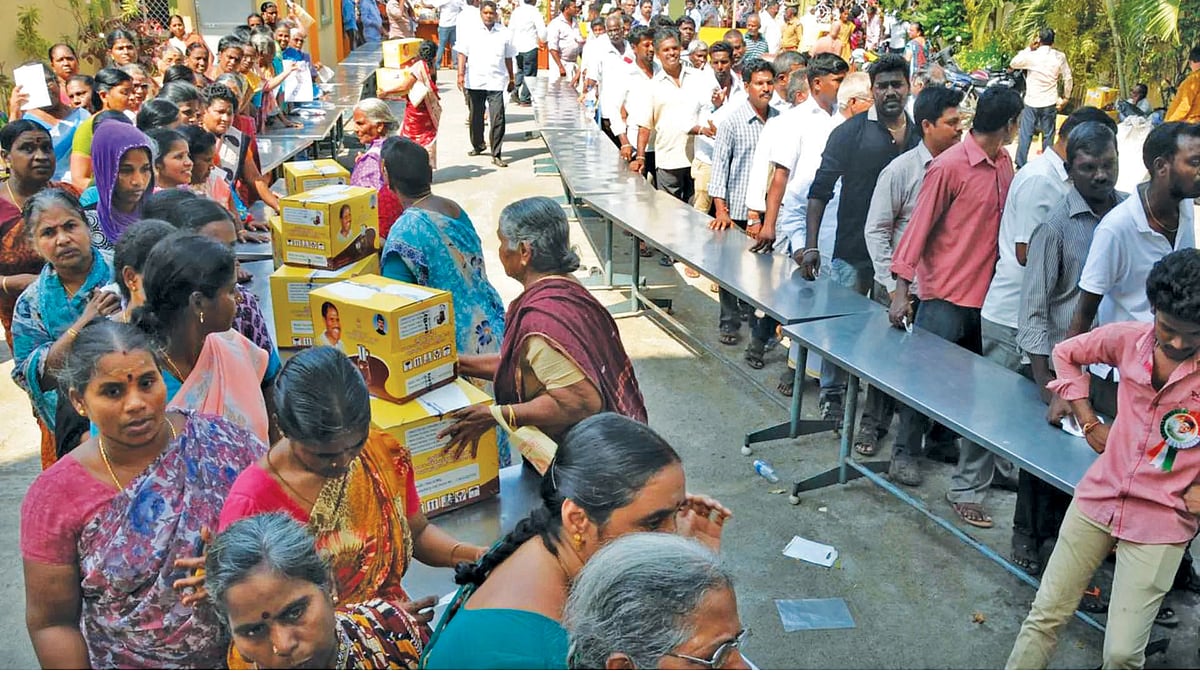
As Tamil Nadu moves towards another assembly election, a familiar script is being replayed. Former chief minister and AIADMK supremo Edappadi K. Palaniswami has announced the ‘first dose’ of the party manifesto: Rs 2,000 a month for women who head ration card-holding families and the extension of free bus travel to men. The ruling DMK has accused the AIADMK of being a copycat, and signalled that its own manifesto will top it.
These early promises underline how welfare politics in Tamil Nadu went from targeted social support to the prime currency of electoral competition. The AIADMK’s two announcements are likely to cost the exchequer close to Rs 40,000 crore annually—that’s around 11 per cent of the state’s projected revenue receipts for 2026-27. The expansion of free transport alone could potentially double an already Rs 3,600 crore subsidy bill.
“This is not welfare anymore in the classical sense,” says C. Lakshmanan, former faculty member at the Madras Institute of Development Studies. “It is a conversion of the budget into an electoral instrument.”
The roots of Tamil Nadu’s welfare culture lie in the ideological foundations of the Dravidian movement which framed the state as an active agent of social transformation. The expansion of public education, the introduction of reservations in government employment, and the strengthening of the public distribution system were all seen as instruments of social justice.
The famous noon meal scheme, first introduced by AIADMK founder M.G. Ramachandran in 1982 was one of the largest such programmes in the world and helped to dramatically improve enrolment among children from poor families. The language was developmental and the idea was that public spending could generate long term social mobility.
The late 1980s and early 1990s saw a shift towards consumer-oriented welfare, but the turning point came in 2006, when the DMK returned to power under M. Karunanidhi. Their manifesto included a promise that would permanently alter the grammar of electoral politics: free colour televisions. Initially targeted at families below the poverty line, it cost the government Rs 3,600 crore in its first phase. Within a few years, it covered nearly 45 lakh households.
“That scheme changed everything,” says P.S. Sreenivasan, a political observer based in Chennai. “Parties realised that an object that sits inside the house is far more powerful than a policy.” From that moment on, Tamil Nadu’s manifestos began to resemble shopping catalogues. Parties competed to offer material goods.
If Karunanidhi pioneered the consumer turn, Jayalalithaa perfected it. After returning to power in 2011, she embarked on an unprecedented expansion—free mixers, grinders, fans, gold for mangalsutras, free laptops, uniforms, textbooks for students, goats and cows for rural households, and free electricity up to a certain consumption limit.
What distinguished Jayalalithaa’s approach was not just variety but scale. Eligibility criteria was diluted or removed altogether.
“Welfare crossed a psychological threshold,” says K. Mohan Raj, a social observer from Coimbatore who has closely tracked rural political behaviour. “People stopped seeing schemes as help and started seeing them as entitlement.”
By the mid-2010s, the question was no longer whether the government should provide benefits, but what kind and in what quantity.
What makes this trajectory particularly striking is that both Dravidian parties had, at different points, experimented with fiscal discipline and market-oriented reforms. These episodes are now largely forgotten, but they hold the key to understanding why competitive populism became so deeply entrenched.
Between 1996 and 2001, the DMK focused on industrial infrastructure, information technology parks, urban renewal projects and public private partnerships. Chennai’s iconic TIDEL Park emerged as a symbol of the state’s IT ambitions. The finance department sought to align Tamil Nadu with the broader economic liberalisation agenda unfolding at the national level.
During her term (2002-2006), Jayalalithaa followed a similar path. She attempted to close loss-making public-sector units, introduced user charges for certain services, curtailed rice subsidies under the public distribution system and invited private investment in the power sector.
Both experiments ended in political disaster. The DMK lost the 2001 election. Jayalalithaa suffered a massive defeat in 2006. The message was unambiguous. Fiscal prudence and market reforms did not translate into electoral rewards.
“That election killed reform politics in Tamil Nadu,” says Lakshmanan. “After 2006, every party understood that you cannot win here by talking about efficiency or fiscal responsibility. You win by expanding welfare and making it visible.” From that point onwards, no major party seriously attempted subsidy rationalisation again.
“After 2006, every party understood that talking about efficiency or fiscal responsibility doesn’t win elections, expanding conspicuous ‘welfare’ does”
The most significant among the latest schemes is the DMK government’s free state-bus travel scheme for women, introduced in 2021. With around four to five crore trips recorded every month, the annual cost is now estimated at over Rs 3,000 crore.
Unlike earlier freebies, free bus travel generated measurable social outcomes. Studies and transport data suggest a sharp increase in women’s mobility, especially among low-income workers, students and informal sector employees. It has reduced daily commuting expenses and expanded access to education and employment.
“This is one scheme where you can see real social impact,” says Sreenivasan. “The danger is that once it becomes politically sacred, nobody will even discuss how to finance it properly. It becomes immune from scrutiny.”
The AIADMK’s proposal for men removes the last remaining targeting principle from the scheme. “This is pure competitive populism,” says Mohan Raj. “One party introduces something useful. The other party makes it bigger just to outdo them. The question of sustainability never enters the conversation.”
Telangana, Karnataka and Madhya Pradesh have already normalised large scale cash schemes targeted at farmers and women. Tamil Nadu is now entering that terrain.
“This is a very dangerous moment fiscally,” says Lakshmanan. “Once you start a universal cash transfer, it is almost impossible to stop.”
The fiscal implications of Palaniswami’s proposal — Rs2,000 per month to the woman heading each ration card-holding family— are enormous. At Rs 24,000 per household per year, even a conservative estimate of 1.5 crore ration cards would translate into a recurring expenditure of around Rs 36,000 crore annually.
Tamil Nadu’s welfare politics is being enacted against a backdrop of growing fiscal stress. The state’s revenue receipts for 2024-25 are an estimated Rs 2.5 lakh crore. Its total outstanding debt has crossed Rs 8 lakh crore. Annual interest payments alone amount to Rs 40,000 crore. Subsidies and welfare schemes already account for between Rs 45,000 and Rs 50,000 crore annually. If new promises worth Rs 40,000 crore are added to this mix, capital expenditure on infrastructure, urban development, industrial promotion and climate adaptation will shrink correspondingly.
“We are slowly moving towards a situation where the government exists mainly to distribute money,” says Sreenivasan.
Despite these concerns, no major political formation shows any inclination to challenge the freebie consensus. The reasons are structural and deeply embedded in the state’s political culture.
Voter expectations have been shaped by three decades of welfare expansion. Entire generations have grown up with free rice, education, electricity… Any attempt to roll back schemes is immediately labelled anti poor or anti-people.
There is no ideological differentiation between the major parties. The competition is over who gives more, not over alternative development models.
Unlike Kerala, where civil society groups and sections of the media actively debate debt and sustainability, Tamil Nadu’s public conversation remains focused on delivery rather than trade-offs.
“People ask what they will get, not what the state will lose,” says Mohan Raj. “There is no political reward for asking hard questions about money.”
Finally, the Supreme Court’s 2013 judgment on freebies criticised the practice but refused to impose any binding restrictions, leaving it to the voter’s wisdom. This legitimised competitive populism.
As the Election Commission prepares to announce the poll schedule, there will be more promises, bigger numbers and grander schemes. The freebie trap will tighten further.
Join our official telegram channel (@nationalherald) and stay updated with the latest headlines