Opinion
Managing conflict, not resolving it
Ukhrul violence reveals the long shadow of unfinished Naga political settlement
On 17 April, the Imphal Times carried a headline: 'CM Khemchand calls for dialogue, peace during emotional visit to various villages of Ukhrul District.' The Manipur chief minister was on a trust-building mission in a bid to bring peace between Nagas and Kukis. He called for dialogue as a way of bringing peace, but of course did not spell out what that dialogue would entail.
His visit to Ukhrul — home to Tangkhul Nagas — came in the aftermath of the latest spurt of violence in which, for the first time since ethnic clashes erupted in Manipur in May 2023, Nagas are being systematically targeted, making an already volatile situation even more violent.
Media tends to forget that there are more than 12 Naga tribes living in Manipur, with some communities spilling across the international border into Myanmar.
What are the causes of this new violence, in which Nagas have become a party? We cannot expect the government, either at the state or the Centre, to present us with facts. The commission of enquiry which is supposed to probe the causes of the 2023 violence has still not submitted its report, its deadline having been further extended to May 2026.
Nagas had remained neutral during the Meitei-Kuki conflict beginning May 2023, despite incidents in which they were targeted but. They kept away, but provided shelter to fleeing Kuki families.
Kuki–Naga violence in Ukhrul began in early February, with an assault on a Tangkhul Naga man at Litan by a group identified as Kuki‑Zo, triggering clashes, stone‑pelting, gunfire and the burning of around 20 houses mostly belonging to Naga villagers in the Litan–Sareikhong area.
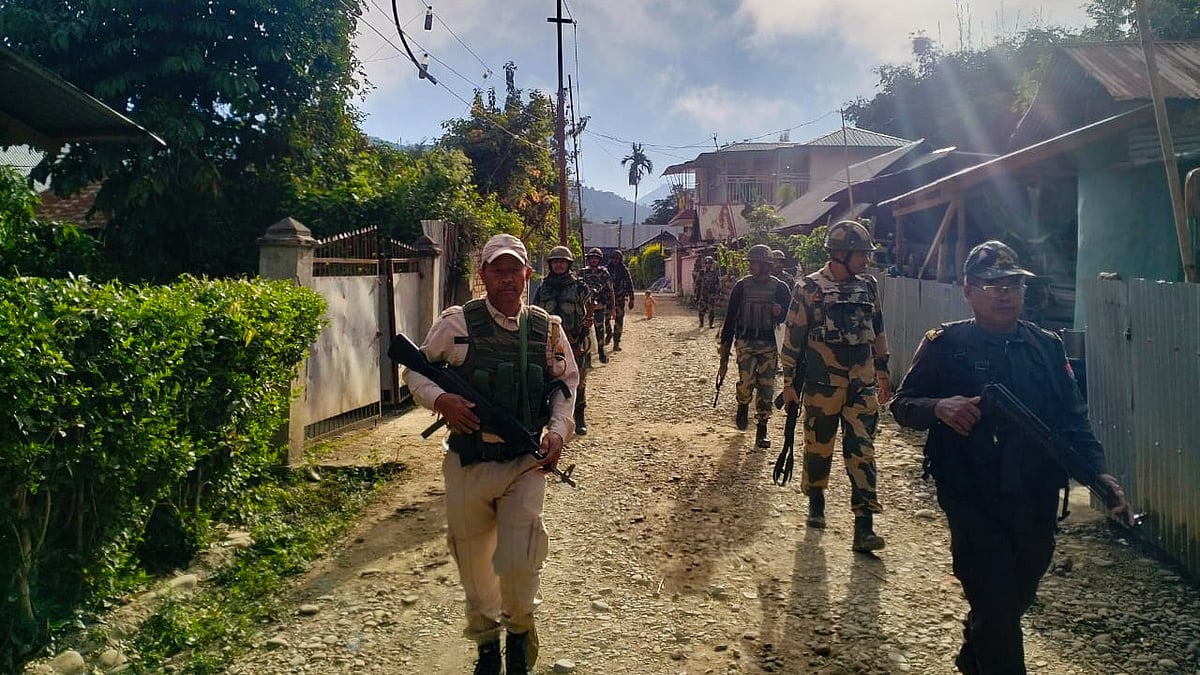
The state imposed curfew and a five‑day internet shutdown, and deployed the Army, Assam Rifles and other forces, with reports of flag marches and area domination to prevent further escalation. However, this did little to restore normalcy.
Then came news of the abduction of 21 Tangkhul Naga civilians — 16 men and five women — on 11 March. The abductees were reportedly detained by armed Kuki villagers while travelling along the Imphal–Ukhrul road. The place of occurrence was the Kuki-dominated Shangkai village in Ukhrul district along National Highway 202.
After intense negotiations, the victims were released, but it was reported that their vehicles, mobile phones, and cash totalling over Rs 8.5 lakh were looted or confiscated. It was also reported that shortly after the release of the 21 civilians, the bodies of two missing Kuki men were found in a forested area, which led to further ethnic tension.
Tangkhul civil organisations have framed the 8 February incident and subsequent abductions of Nagas as “calculated aggression” against Tangkhul Nagas, explicitly accusing “Kuki militants” of targeting Nagas in Ukhrul and elsewhere.
It is important to see these individual incidents in the context of past grievances. First, it should be remembered that more than 10 different Naga tribes have been living in Manipur spread over several districts of the State.
This article focuses on the attacks on Tangkhul Nagas of Ukhrul, the tribe to which Th Muivah, general-secretary of the National Socialist Council of Nagalim (I-M) belongs. Ukhrul has been a hub of the insurgency led by NSCN (I-M), which signed a ceasefire agreement with the government of India in 1997. However, the peace talks which began in 1997 have failed to produce concrete results, and made the political situation even more volatile.
Indeed, the ceasefire has been one reason for the failure of talks. Nagas wanted the ceasefire to extend to the Naga areas of Manipur, more specifically Ukhrul. Meiteis opposed the extension of the ceasefire because they did not want to admit that there were Nagas living in Manipur, since such an admission could perhaps legitimise the Naga demand for integration of Naga-inhabited areas of Manipur (and Assam and Arunachal Pradesh) with Nagaland.
Nagas have pointed out that the creation of Nagaland itself was part of India’s counter-insurgency programme to divide Nagas of Nagaland and Manipur.
But the Naga demand for integration was opposed by Kukis as well, citing the demand for a Kuki homeland called Zai’langam which includes Ukhrul district. Nagas have opposed Kuki-Zo demand for a separate district, which would include a majority of Naga communities. In 2016, when the Manipur government announced the creation of seven new districts, Nagas stood in opposition because they felt the new districts were being created to undermine Naga unity and as a concession to Kukis.
Commenting on the creation of the seven districts, the Institute for Defence Studies and Analyses observed in an article: 'The Manipur government had announced the creation of the seven new districts post haste without having the basic infrastructure in place. While Chief Minister Ibobi Singh reiterated that the creation of these new districts is a response to the longstanding demands of the local people as well as for reasons of administrative convenience, Naga leaders feel that it was an attempt to divide the Naga people by merging them with non-Naga areas to form the new districts.
'Further, they have also taken exception to the Manipur government not consulting the Hill Area Committees before taking the decision. And they have questioned the timing of the decision, which, in their view, was driven by political considerations keeping the recently concluded assembly elections in mind.'
The IDSA brief points out that 'there were four Memoranda of Understanding signed between the Naga civil society and the Manipur Government. According to these, all stake holders would be consulted and the land rights of Naga people would be ensured. Given this, the Nagas perceive the creation of the seven new districts without consulting the stakeholders as a demonstration of utter disregard for the four memoranda as well as for the assurances given to them about consultations on matters affecting them'.
Naga grievances have been compounded by the Manipur government's discrimination against hill districts in terms of fund allocation and development. Added to which the Manipur Assembly has only 40 members from hill districts (Naga-Kuki combined) whereas Meiteis have 60 members.
Moreover, Indian intelligence agencies have worked overtime to divide and rule, setting both Nagas against other communities but also intervening in Naga society itself and creating divisions among the insurgents. For instance, the Naga National Political Groups (NNPGs), a coalition of seven Naga insurgent outfits, are involved in separate negotiations.
Intra-Naga clashes have been seen in Manipur between different armed groups. On 29 March, an angry mob in Ukhrul town set fire to the NSCN‑IM’s regional office after news spread that four NSCN 'Eastern Flank' cadres had been killed in a suspected factional attack in neighbouring Kamjong district (carved out of Ukhrul) the previous night.
On the night of 28 March, at around 8.30–9.00 pm, a vehicle carrying six cadres of the Eastern Flank was intercepted near Hongbei village junction in Kamjong district. Attackers opened fire on the vehicle, killing four cadres on the spot while two reportedly escaped; the bodies were recovered later by a police team.
The Eastern Flank alleged that the ambush was carried out by a rival armed group, naming individual NSCN‑IM-linked figures, and accused NSCN‑IM of involvement, which fuelled local anger. NSCN‑IM has publicly denied ordering or authorising any offensive action against rival factions in this period, calling itself “shocked and grief‑stricken” by the killings.
The Eastern Flank is led by Ramsan, who has had differences with the NSCN (IM). A security analyst told The Print that Ramsan also has close ties with China and is opposed to the smart wall proposed by the government of India to be built between India and Myanmar.
The China factor in the Northeast has been largely ignored by the media, though it is of considerable concern to the security establishment. And that is linked to the developments in Myanmar. The Manipur situation cannot be understood without a reference to the developments in Myanmar, with which it shares an almost 400-km border. This border area is known for drug trafficking and arms smuggling as well as insurgency. Each of these issues needs to be addressed separately.
One of the main grievances of Nagas in Manipur is the infiltration of Kukis from Myanmar. These are not bona fide refugees but migrants who have settled on Naga lands, and the exponential growth of Kuki villages in Naga-inhabited areas including Ukhrul seems to corroborate this concern.
Nagas allege that the government of India is 'using' Kuki militants under the SoS framework as a proxy force in Naga areas, implying that security forces, including Assam Rifles, are either complicit or not acting decisively to protect Nagas from Kuki attacks. Reports from various responsible sources have repeatedly alleged that Kukis are attacking Nagas in Ukhrul with Assam Rifles just watching from the sidelines, and that Chin armed groups in Myanmar are supporting Kukis.
Home ministry communications and media investigation have linked Chin/ Kuki‑Zo networks across the border to funding, training, and arms flows for Kuki groups to perpetrate violence in Manipur and pursue a larger Chin‑Kuki‑Zo state spanning Manipur, Myanmar and Bangladesh.
The question is, why can't Indian security forces protect the Nagas in this particular situation? Indeed, Nagas accuse the Assam Rifles of working with a section of Kukis in counter-insurgency operations from the early 1980s. The allegations of corruption and bias are levelled specifically against the Assam Rifles, sometimes even against specific battalions.
In fact, both Nagas and Meiteis have complained about the Assam Rifles' role in counter-insurgency operations both in the Imphal Valley and in the hills. The force has also been accused of committing large-scale violations of human rights by human rights activists.
Even former chief minister Rishang Keising, a Tangkhul Naga and an ardent Congressman hated by Naga insurgents, had written in a memo to the then President of India in the aftermath of the NSCN attack on an Assam Rifles post in Oinam village in Senapati District in July 1987: '…Civil Rule, has, unfortunately, ceased to operate in Senapati District of Manipur due to excesses committed by the Assam Rifles with complete disregard shown to the civil administration.
'The Assam Rifles are running the parallel administration in the area. The Deputy Commissioner and the Superintendent of Police were wrongfully confined, humiliated and prevented from discharging their official duties by the Security forces. The Chairman, Hill Autonomous District Council was forced to proceed on foot from national highway upto Oinam village and confined during the night and thereby prevented from discharging his official functions.
'Whereas the acts of certain misguided elements need to be condemned strongly, we can hardly afford to term the entire population as anti-national as being projected by the Assam Rifles. This is an extremely dangerous trend which must be avoided at all costs. We shall request you to kindly use your good offices to restore the rule of law in the affected areas immediately.
'…..Finally, we shall be most grateful to you, Sir, for paying august visit to the State and offer an opportunity to vent our feelings. We are, let me assure you, committed to the maintenance of unity and integrity of the country which is dearest to our lives for which no sacrifice is too great.'
However, the government paid no heed to Keishing’s warnings, then or now. Meanwhile, the people of Manipur across communities continue to suffer. This is not merely a breakdown of law and order or an ethnic conflict, but an entrenched, low‑intensity, civil war‑like situation.
The writer is a human rights lawyer and author, along with Sebastian Hongray, of The Judgement that Never Came: Army Rule in Northeast India and other works. More of her writings here
Join our official telegram channel (@nationalherald) and stay updated with the latest headlines