Opinion
The rules of the game have changed — will the game change too?
An inflection point for India's democracy, student protests and an Opposition that must decide whether to keep playing by rules it says have changed
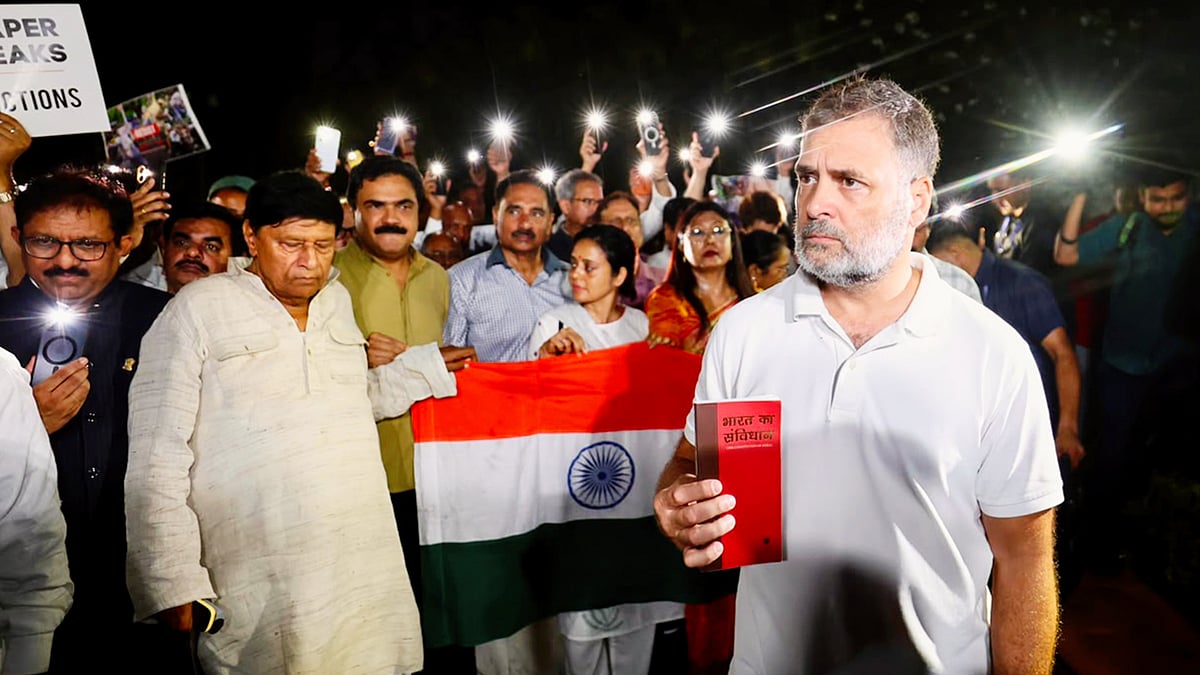
Any game, or contract, is based on, and presupposes, mutually accepted rules which govern and bind the participants. Democracy is one such contract, the ultimate social contract, in which the citizens (the ruled) give up their individual powers to the elected government (the ruler) in return for the protection of their rights, freedoms and the pursuit of happiness in their own individual ways.
In India, so far, for the last 75 years, this contract has held together, though it has come under strain many times. The credit for this goes to enlightened leadership and constitutional institutions that have usually worked, notwithstanding some blips and glitches.
But over the last decade or so, the authoritarian, unilateral, anti-federal and non-accountable governance style of the NDA government has put this contract under immense strain, and on 20 July it came close to breaking point.
The impetus behind it is the Modi government's paranoia about any kind of protest or opposition to its policies and diktats — it views them as challenges, and not as opportunities to introspect and/or self-correct. This happened with the Assam NRC, the CAA, Covid, Manipur, Article 370 and Kashmir, SIR, and the Ken-Betwa protests.
But on 20 July, this paranoia reached new heights (or lows) when the full might of the state was unleashed on young students, and blood was spilt on the streets of Delhi, all over a protest against India's rancid and corrupt examination system.
By this unjustified violence, the government has broken the contract with its citizens. Sovereign violence is to be used against enemies of the state, and not against its own children. A government which cannot differentiate between the two has finally exposed its fascist, illiberal, intolerant and dictatorial nature, and the Jantar Mantar protests have shown it in all its ugly nakedness.
Despite the prostitution of the darbari media and TV channels, the internet and YouTube have brought this to the doors of every Indian, and support for the students is only growing.
The unkindest cut of all (to the spirit of democracy) has been inflicted by none other than the Chief Justice of India himself, Justice Surya Kant. Perhaps this should have been expected, for it was his earlier intemperate remark about cockroaches that led to this spiral of events in the first place.
Responding to a PIL by a lawyer seeking an inquiry into the police excesses of 20 July, the CJI peremptorily dismissed it with the observation that he did not have the time to watch videos (of the police violence on protesters). This was a remark that was callous and unbecoming of a person appointed to protect the constitutional rights of citizens.
He was not being petitioned to watch a Kangana Ranaut movie, but to view the documented evidence of unlawful violence on unarmed teenagers, and to seek answers from the government on questions that screamed out for answers. Who were the 'brownshirts', masked and in civvies, who were allowed to beat up students with lathis with total impunity while the police watched?
How did a truck laden with stones find its way to the high-security Jantar Mantar area, and who brought it? Why were peacefully marching students beaten up brutally without any provocation? Why did the policemen take off their name badges? What is the identity of the jawan who is seen ramming his baton between a young girl's legs even as she is walking away? What is the name of the DCP who walks up to one young girl and slaps her in the face for no reason at all?
Where is the footage of protesters throwing stones and beating up policemen, as alleged by the government? Were illegal lethal weapons such as pellet guns, taser (electrically charged) batons and nail-studded lathis used against the students? Who are the goons, in plain clothes, seen throwing stones and wrecking cars? Was there a deliberate attempt to discredit the protesters and provoke violence?
The refusal of the CJI to entertain this petition and seek answers to the questions above has thrown an obfuscatory veil over the events of 20 July, not dissimilar to the white sheet used to cover the abduction of Sonam Wangchuk from Jantar Mantar by the same police.
In contrast, however, credit must be given to the justices of the Delhi High Court who, on 22 July, admitted a similar petition and issued notice to the government and the Delhi Police (though the petition demanded an urgent hearing and not a four-week notice).
This is a moment of inflection for the entire non-NDA Opposition. They have to live up to it, which, at the moment, they do not appear to be doing. They cannot plough their own individual furrows, headed for nowhere, but must come together to offer counsel and guidance to these gallant students, who are full of passion and sincerity but lack the experience of conducting long-drawn-out protests.
At the moment, there is no sign of such concerted action on the part of these parties, each of whom is trying to take credit for, and control of, this movement. The Congress wants the agitation to come under its umbrella, the AAP feels this right is theirs as the legal heir of the Anna movement, the Left and UBT Shiv Sena seem to have some reservations, the TMC is supportive but distant, the DMK will not sup with the Congress, and even Wangchuk has called off his fast, a not unexpected development since he had started blowing hot and cold of late. (In my view, he has probably struck a deal with the government about his personal future in Ladakh. In any case, he has now become irrelevant to the movement.)
The entire Opposition should realise (as these youngsters have) that the rules of the game have changed. The government will not abide by its part of the contract: it will not conduct fair elections; it has suborned all agencies of governance; it has defenestrated constitutional institutions; it has rendered the entire judiciary submissive; it has bought over the media; it has made the use of sovereign violence its greatest persuader; and it refuses to be held accountable.
With these rules, the Opposition has become superfluous. It can never win an election or preserve even a semblance of democracy in the country. It can no longer wage a struggle in Parliament, the Election Commission or the Supreme Court — these institutions have been hollowed out and can no longer serve the purpose for which they were created.
It can no longer fight a fair electoral contest — the game now has to change to one of resistance in the public arena: at Jantar Mantar, Parade Grounds, Azad Maidan, Freedom Park, Ramlila Maidan, Swami Sivananda Salai, Dharna Chowk and Gandhi Maidan. The students are already there, and doing a fine job; it is the responsibility of the main Opposition parties to join them there. Credit can be apportioned or shared when the monster has been vanquished.
"There is a tide in the affairs of men, which, taken at the flood, leads on to fortune..." Rahul Gandhi has no doubt read this quote from Shakespeare; he now needs to embrace it. The students at Jantar Mantar have created this tide. It is now for him to rally the other Opposition parties, national and regional, to seize the moment.
The game has changed, and playing by the BJP's new rules will get them nowhere. The Empire has already begun to strike back, using its bottomless bag of tricks: another 20 companies of the CRPF have reportedly been flown into Delhi; the Police Commissioner has been given powers under the NSA to detain people for 12 months without trial; it has been stated that the passports of detained protesters will be cancelled; and a petition has been filed in the Delhi High Court seeking an NIA investigation into the funding of the CJP (Cockroach Janata Party) protests.
More can be expected: curbs on YouTube channels over their reporting, profiling of protesters and visits to their parents, debarring them from admissions or from sitting examinations. It is not possible to resist the resources of a modern state for very long. Very soon the tide will begin to turn, and then the opportunity will have been lost — for ever.
Views are personal. More of the writer's works here
Avay Shukla is a retired IAS officer and author of Holy Cows and Loose Cannons — the Duffer Zone Chronicles and other works. He blogs at avayshukla.blogspot.com
Join our official telegram channel (@nationalherald) and stay updated with the latest headlines