Opinion
“We didn’t pay for fish, now we worry about jobs”
Pankaj Chaturvedi writes the obituary of a way of life as the development juggernaut rolls on in the Great Nicobar
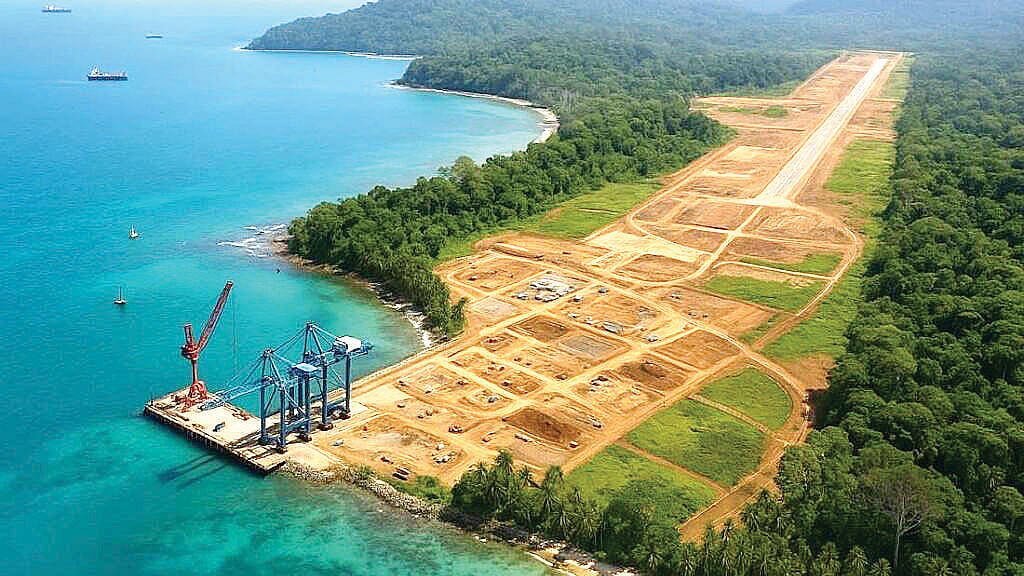
Conservation, prime minister Narendra Modi once said, is an article of faith for his government. Yet the drift of his government’s ‘development’ drive—be it in the Himalayan state of Uttarakhand or the country’s forest areas or the island outposts of Lakshadweep and the Andaman and Nicobar Islands— suggests the exact opposite. Let’s take, for example, the misleadingly named ‘The Great Nicobar Holistic Development Project (emphasis added).
Despite environmental red flags, ethical concerns and legal hurdles, the government looks all set to clear the Rs 92,000 crore infrastructure push to transform the southern Andaman and Nicobar Islands into a strategic maritime hub near the Malacca Strait.
Envisaged as one of the world’s busiest transhipment ports, the project includes an airport large enough to allow the largest commercial aircraft to land, a township for an initial population of 3.5 lakh, a power plant and demarcated areas for ‘tourist resorts’. The scale is unimaginable for the fragile Andaman and Nicobar Islands, if concern for the environment is any sort of consideration. But, of course, the development juggernaut must roll on.
The environmental clearances for the project are before a bench of the National Green Tribunal (NGT), which had reserved its order in November last year. The forest clearances have been challenged in the Calcutta High Court, where the matter has been posted for ‘final hearing’ in the week beginning 30 March.
Meanwhile, serious allegations have emerged from the islanders. On 22 January the Tribal Council in Little and Great Nicobar alleged it was being pressured to “surrender our ancestral land”. Council chairman Barnabas Manju, said officials called a meeting on 7 January at the PWD guesthouse in Campbell Bay, produced maps of the project area, sought the views of council members of the Andaman Adim Janjati Vikas Samiti (AAJVS) and asked them to sign a ‘surrender certificate’. The AAJVS is an autonomous body established in 1976 under the Registration of Societies Act 1861, dedicated to the protection, welfare and development of the Particularly Vulnerable Tribal Groups (PVTGs) in the Andaman and Nicobar Islands. “The meeting lasted barely ten minutes,” Manju said.
Earlier, in August 2025, the Tribal Council had in a letter to Union tribal affairs minister Jual Oram complained that the A&NI administration had made a ‘false representation’ to the Centre claiming that forest rights of locals had been identified and settled as per provisions of the Forest Rights Act (FRA) when, in fact, the processes had “not even been initiated”.
“If our forest rights have truly been settled, why are we being asked to sign a ‘surrender certificate’?” asked Manju.
The Tribal Council letter further states: ‘The Gram Sabha that is said to have given consent for forest diversion did not include the Nicobarese of Great Nicobar whose ancestral villages—Chingenh, Haeng Loi, Pulo Baha, Kokeon, Pulo Pakka and others— will be directly affected by the proposed project.’ These villages were evacuated after the 2004 tsunami and residents assured they would eventually return to their ancestral land. But the government has only now revealed its hand.
The project, warn anthropologists and activists, threatens some of the most vulnerable indigenous communities in the world. They point out that decades of state intervention have severely damaged the heritage, culture and environment of tribes like the Jarawas, the Great Andamanese and the Shompen.
The extent of damage to the fragile ecosystem of Andaman and Nicobar Islands is unimaginable
The tribes are presented to tourists as exotic curiosities, the activists say with disgust. If they refuse to oblige, mainland settlers are dressed up as Jarawas and made to dance at the airport to welcome visitors. Jarawas, who for centuries had no interaction with the outside world, have been taught to wear clothes and forced to beg for money, alcohol and even betel leaves.
The ‘mission’ to ‘civilise’ the tribes has radically altered their lifestyle. “Earlier we never needed money,” says an ‘educated’ woman from the Great Nicobarese tribe. “We did not pay for fish, forest produce or coconut. Now we worry about money and jobs.” What is worse, she adds, is that there are no jobs. Children are refusing to attend school questioning the need for education when educated adults sit at home. “We have always been calm, peace-loving people; anger was alien to us, but now many of us get angry,” she says.
Activists recall the efforts by officials to enrol the Shompen as voters. The Shompen, they say, have no concept of nation states, leave alone politics or political parties. UNESCO estimates their population at around 200, and even today there is little clarity on their numbers or location. “Yet we are hell-bent on delivering development to people we barely understand,” says one activist.
The southernmost island of the Nicobar archipelago, the Great Nicobar Biosphere reserve alone spans over 103,000 hectares of tropical evergreen forest and is home to nearly 650 plant species and more than 1,800 animal species, many of them endemic.
The government argues that the project is strategically vital. Great Nicobar is located near major international shipping routes. Its proximity to the Malacca Strait is frequently cited. A naval presence already exists here and ex-servicemen have been resettled in parts of the islands. Critics do not deny the strategic considerations but ask why the government is not keen on port expansion in Chennai or Visakhapatnam.
Environmental concerns remain central. While the government claims that fewer than one million trees will be felled, activists estimate the figure to be six or seven times higher. The Andaman and Nicobar Islands—a cluster of 572 islands—were recognised by UNESCO in 2013 under its Man and Biosphere Programme.
The project also plans to increase the population of the Nicobar islands from an estimated 8,000 tribespeople to over half a million. Activists describe this as cultural genocide with a devastating effect on the health, language and culture of the tribespeople. The Tribal Council suggested that development be allowed outside the tribal habitation, but this has been ignored.
Even worse, the environmental damage in Great Nicobar is supposed to be ‘compensated’ with afforestation in Haryana or Madhya Pradesh! This obviously makes no sense to communities whose livelihoods depend on their coconut groves, pandanus trees and forest produce and fruits or whose lands hold graves and sacred places. But faced with the might of a marauding state and powerful corporate interests, they are left with little room to resist.
Join our official telegram channel (@nationalherald) and stay updated with the latest headlines