POLITICS
How the deep south was won
The Left has lost its way, and the UDF must carry the lessons from a great victory into governance for the people. It’s delivery time now in Kerala
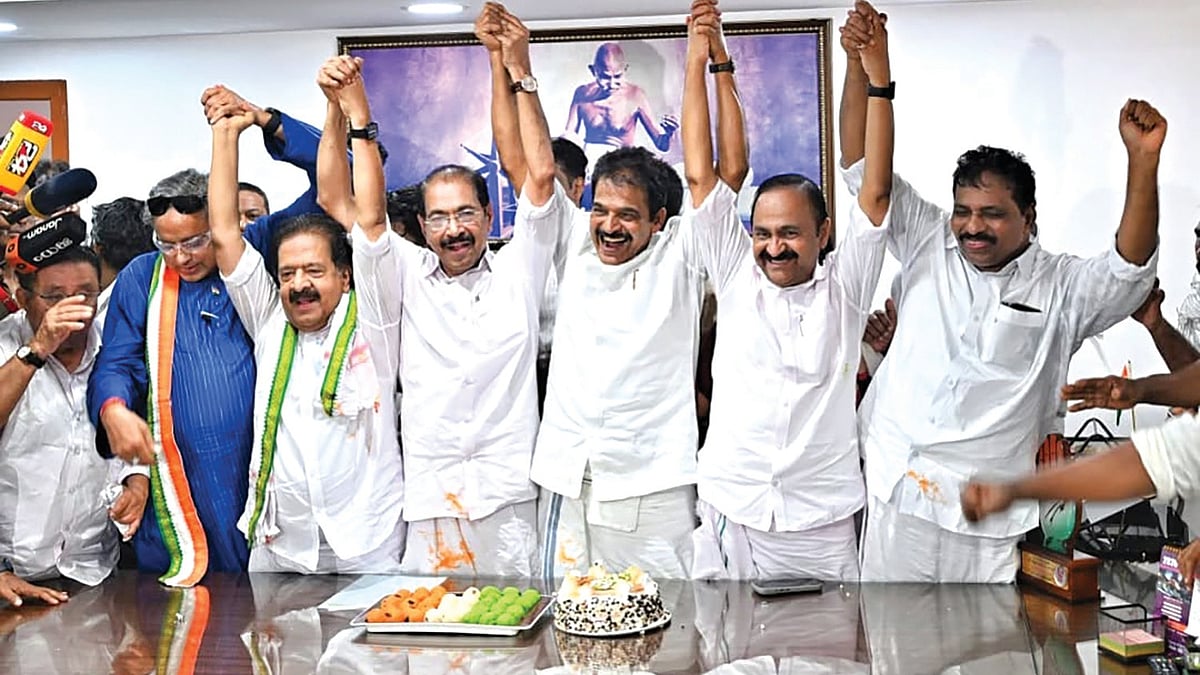
The verdict in Kerala on 4 May was not just a vote for change. Nor merely an expression of anti-incumbency as many commentators had you think. It was also a rejection of the divisive politics of the BJP, which did its damnedest to split the vote on communal lines. The party still managed 11.4 per cent of the vote—signalling that the rot may have set in here too—but it wasn’t enough to deliver any more than the three seats it managed. Three seats too many, for many Keralans.
The Congress-led UDF (United Democratic Front) secured a decisive 102 seats in the 140-member assembly and the CPI(M)-led LDF (Left Democratic Front) saw a big contraction. That contraction was in large measure a verdict on outgoing chief minister Pinarayi Vijayan’s style of functioning—the cult of personality and the extreme concentration of power in his own hands as also his attempts to make nice with the BJP to stay afloat. It took seven rounds of counting for Vijayan to establish a lead in Left citadel Dharmadam and his final margin of victory was much slimmer than the 50,000+ votes in 2021. Thirteen of his cabinet ministers lost.
For a long time, factionalism had been the bane of the Congress in Kerala, often spilling into the public domain. And while contesting personal ambitions did again surface after the results, in the run-up to the elections, the party held together. Candidate selection, always a fraught affair, was handled with remarkable smoothness. No public altercations, no competing lists, no late-stage rebellions.
This unity was not accidental; it was managed with care. Party general secretary (organisation) K.C. Venugopal and Ramesh Chennithala took the lead in handling dissent, engaging with aspirants and ensuring that grievances were resolved internally. The emphasis was clear and consistent: winnability would override factional claims. That message stuck.
This rare organisational discipline translated into electoral coherence. The UDF looked a coordinated political unit, not a ragtag group carrying the same banner. This unity allowed the alliance to focus sharply on the electorate instead of itself, a critical advantage in a contest that was expected to be tight.
At the campaign level, V.D. Satheesan, leader of the opposition in the previous house, was the principal voice of this reset. His messaging was measured, consistent and rooted in governance concerns. “This verdict is about restoring democratic functioning and accountability,” he said after the results.
The Congress has improved not just its tally of seats—from 22 in 2016 and 21 in 2021 to 63 this time—but also its vote share (28.8 per cent from 25.1 per cent in 2021). Allies like the IUML (Indian Union Muslim League) retained their strongholds. In central Kerala, several constituencies returned to the UDF. In Malabar, traditionally a Left stronghold, the margins narrowed sharply and several seats flipped. Urban and semi-urban constituencies also recorded a shift, driven by economic anxieties and governance concerns.
One of the most consequential aspects of this election was the consolidation of Muslim and Christian voters behind the UDF, whose assurances clearly carried more credibility with these voters. IUML all-India general secretary P.K. Kunhalikutty said this shift was pivotal to the outcome. “People wanted a government that respects diversity and listens. That trust came back to the UDF,” he said. The IUML’s steady performance in Malabar anchored UDF gains. And the BJP’s outreach to sections of the Church, in an attempt to disrupt settled social equations, failed to make an impact in the vote.
The unravelling of the Left
The UDF did also benefit from voter dissatisfaction with the Left ecosystem. Local discontent among CPI(M) cadres and sympathisers further weakened the LDF organisationally.
But the LDF’s defeat cannot be understood without examining the nature of its governance. Under Pinarayi Vijayan, the government projected decisiveness and administrative control. In the early days, this was seen as strength and efficiency, but over time, it began to look like something else—concentration of power and centralised decision-making.
The space for internal dissent shrank. Critics within the Left ecosystem started talking about an arrogant leadership that discouraged debate.
The Left in Kerala has historically sworn by collective leadership and ideological engagement. But under Vijayan, the political culture changed dramatically, from governance by (party) consensus to governance by decree. For a cadre-based movement, that transition was radical.
The LDF campaign relied too much on past achievements in welfare and infrastructure. Those achievements are no doubt substantial, but not brag-worthy any more in Kerala, whose voters are used to better base-level human development indicators than, say, the Hindi heartland states. The LDF’s poll campaign was found wanting on emerging concerns such as unemployment and the rising cost of living. CPI state secretary Binoy Viswam admitted the need for introspection: “We must examine where we failed to connect with the people.”
The SilverLine project (a.k.a. K-Rail)—a proposed 530 km semi-high-speed railway line connecting state capital Thiruvananthapuram in the state’s south to Kasaragod in the north—was another flashpoint during the election. Projected by the LDF government as a transformative infrastructure initiative, it had triggered much concern over displacement, financial viability and its environmental impact. Protests spread across districts, and the government’s response was seen as dismissive.
The UDF managed to reframe the debate to its advantage—arguing for development that is also sustainable and not thrust upon people. This resonated with a wide cross-section of voters, from farmers to middle-class households.
Even police action during protests—over large projects like SilverLine or even local agitations—and the government’s tendency to justify police action by default had reinforced the perception of an intolerant state administration.
In the run-up to the election, the LDF would have sensed the changing public mood, and it tried to head off imminent voter rejection with a publicity blitz. But, if anything, the high-decibel PR campaign amplified the gap between the official narrative and everyday reality.
The Left, which no doubt played a big hand in Kerala’s social development, does not have a clear path to renewal; it certainly cannot live off its legacy forever.
The UDF has reason to feel chuffed with this hard-won victory, but the mandate comes with high expectations, and only good governance can grow their political capital.
The Kerala verdict carries significance beyond the state. It holds lessons for an Opposition that is up against phenomenal odds. The UDF campaign was united, disciplined and internally consistent, its leadership looked well-coordinated and its message was clear. Differences were managed well and didn’t spill into the public domain. Leaders spoke in one voice. The campaign stayed focused. It takes all of that when you’re fighting with your back to the wall.
Join our official telegram channel (@nationalherald) and stay updated with the latest headlines