


RSS isn’t changing, it’s unfolding: Bhagwat’s botanical spin
From NGO rebranding to silent governance muscle, the century-old RSS keeps evolving — just not in ways it admits
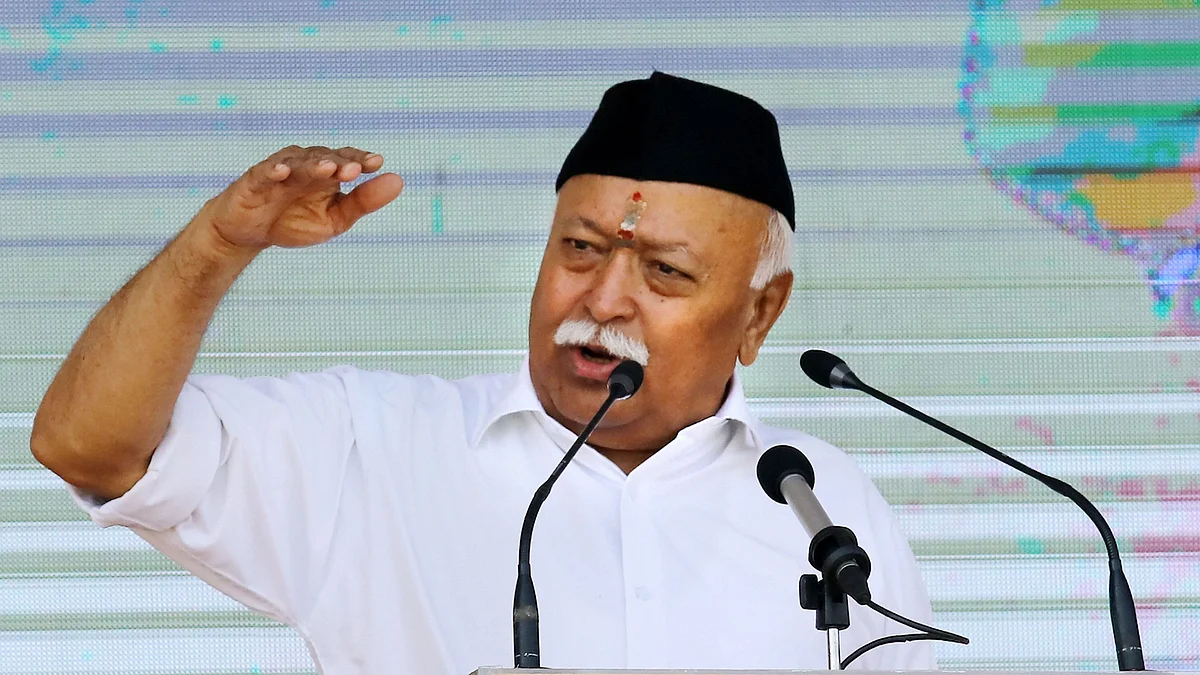


Mohan Bhagwat insists the Rashtriya Swayamsevak Sangh (RSS) isn’t changing — it’s just “evolving” and “unfolding” like a cosmic banyan seed that refuses to be pinned down, no matter how out of step its actions look with its century-old self.
That was basically his takeaway on Sunday at the song-album launch for the forthcoming Shatak, a film celebrating 100 years of the Sangh’s self-portrait. Singer Sukhwinder Singh and various RSS dignitaries nodded along.
According to Bhagwat’s tree metaphor, if you see the Sangh’s modern ideological zig-zags as a change, it’s only because you’re looking at the form — not the “fundamental essence” seeded by founder Dr Keshav Baliram Hedgewar.
Hedgewar, a boy orphaned by plague at 11 who never “let his nature waver”, gets elevated not just to ideological progenitor, but a psychological archetype worthy of academic inquiry. Never mind that his core vision — Hindutva as a social and political organising principle — has historically been far more exclusionary than its current PR gloss.
What Bhagwat didn’t address in his speech was something more immediate: public scrutiny about how an organisation with deep political influence has managed to stay largely unregistered in the eyes of Indian law.
Asked in the past why the RSS doesn’t formally register like any other NGO, trust, or society, Bhagwat’s answer was breezy: the RSS is a “body of individuals”, and Indian law doesn’t force such bodies to register — much like Hindu dharma itself, which also lacks paperwork.
That means it doesn’t have a formal legal personality with consolidated tax filings or mandatory disclosures, even though it’s arguably one of the most influential civil society actors in the country.
This is exactly the ambiguity Prime Minister Narendra Modi leant into when he lauded the RSS from the Red Fort on Independence Day 2025, calling it the “biggest NGO in the world” dedicated to nation-building.
That line — technically harmless but politically loaded — gives the organisation a glossy, non-threatening label, even as many of its ideological affiliates and cadres fill government posts, shape public policy, and embed Sangh ideas across education, culture, and administrative networks. It’s a clever rebrand: voluntary social work, not political engineering.
Of course, “biggest NGO” has a mildly absurd ring when you remember that unlike typical NGOs — which register, publish accounts, and are accountable under Indian laws — the RSS has repeatedly declined that transparency and operates through a sprawling, opaque network of shakhas and offshoot groups.
The lack of registration lets it avoid centralised scrutiny over funding, membership lists, or governance structures, even as its philosophy directly shapes national discourse. Critics point out that this arrangement looks a lot like influence without accountability; defenders frame it as patriotic voluntarism untethered from bureaucratic red tape.
And while the Sangh likes to claim it only supports policies, not parties, in practice it has been the intellectual and organisational bedrock of the ruling BJP for decades — so much so that the RSS worldview filters into everything from administrative appointments to legislative priorities. Policy support, in this context, often translates to governing influence without direct electoral responsibility.
All of which makes Bhagwat’s role even more curious: despite touting voluntarism and grassroots ethos, he travels with a Z-category security detail — the kind usually reserved for top politicians and figures perceived to have substantial threat perceptions on the national stage. In other words, the leader of an unregistered body that claims it isn’t political nonetheless gets protection on par with the country’s VIP class, paid for by the state. (If that isn’t one of the strangest ironies of Indian civic life, what is?)
So when Bhagwat says the RSS isn’t “changing” — just unfolding — the phrase works on multiple levels: it unfolds Hedgewar’s sanitised origin story, unfolds a status that remains legally unanchored yet politically omnipresent, and unfolds an institutional narrative that insists it’s a peerless NGO even as it shapes government from within. Call it evolution, adaptation, or just good old PR — but let’s not pretend the unfolding is happening in a vacuum.
With PTI inputs
Join our official telegram channel (@nationalherald) and stay updated with the latest headlines