Nation
The National Herald case: BJP’s political vendetta project hits a roadblock
Special Judge Vishal Gogne’s intervention on 16 December shows that the independence of the judiciary has not yet been snuffed out
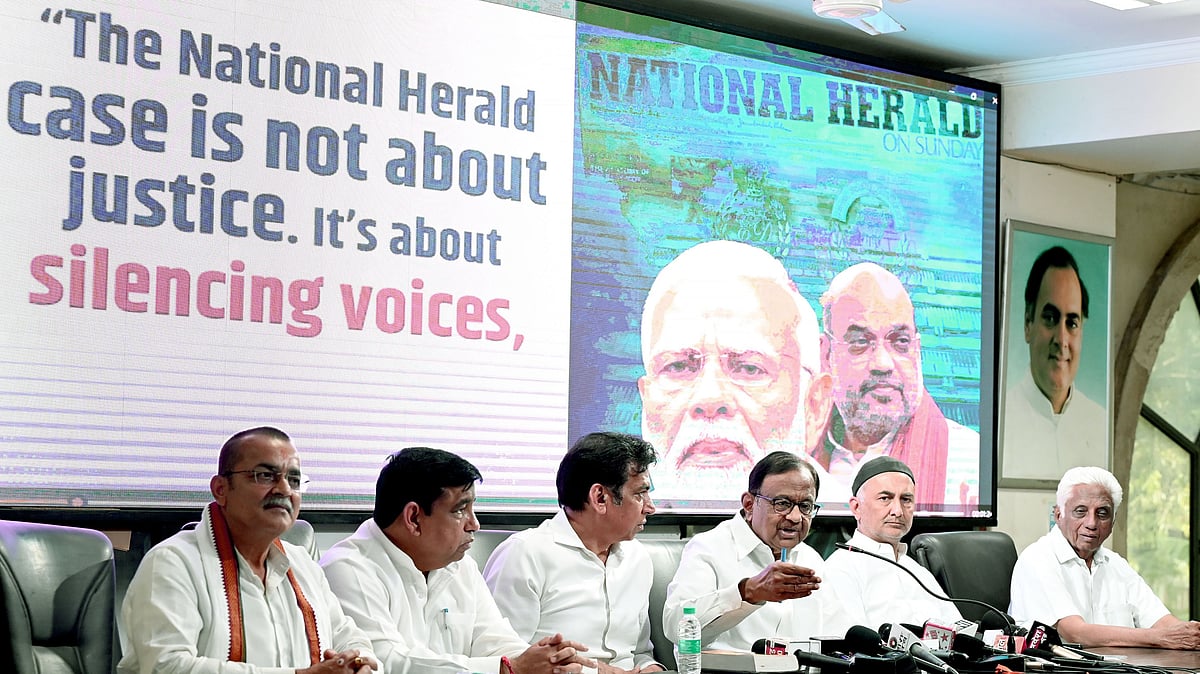
In an era when even the Supreme Court of India has been bending to the will of the Modi government, it is heartening to see a lower court of India standing firm in defence of the laws of the land both in letter and in spirit. That is what Special Judge Vishal Gogne did at the Rouse Avenue trial court in Delhi on 16 December this year.
The case he dismissed was a charge filed by the Enforcement Directorate (ED) in 2021, that the shareholders of Young Indian—the holding company of Associated Journals Ltd, which publishes this newspaper—had misappropriated funds to the tune of Rs 90.21 crore to gain control of AJL’s substantial fixed assets. This, in the ED’s framing, constituted money laundering.
Refusing to take cognisance of the ED complaint (chargesheet) against Sonia Gandhi, Rahul Gandhi and others in the case, Judge Gogne ruled that the complaint was “not maintainable” under the Prevention of Money Laundering Act (PMLA), because an investigation and prosecution under PMLA cannot proceed without a prior FIR (First Information Report) for the underlying scheduled (predicate) offence.
Judge Gogne’s reason for doing so was precise and irrefutable. The original accusation of ‘money laundering’ had been made by a private person—Subramanian Swamy. Swamy’s charge should have been investigated by a government agency, i.e., the CBI. The CBI should then have filed an FIR (First Information Report) submitting its findings to the ED. The Enforcement Directorate would only then have had the authority to start investigating the charge of money laundering against the accused. But the Directorate had not received, nor waited to receive, a report from the CBI, or any other agency designated by it, and filed a case against the accused solely upon the basis of a complaint made by a private person. Rightly therefore, Judge Gogne saw no option but to throw out the case.
Why did the ED not follow procedure before filing a case in court? The chronology is revealing.
It was in February 2013 that Swamy filed his private complaint with the Metropolitan Magistrate (trial court) in New Delhi, alleging that the shareholders and directors of Young Indian had committed fraud, misappropriated funds, and were in criminal breach of trust against the Congress Party, donors to the Congress Party, AJL and shareholders of AJL.
Without any verification based on documentary material, the Metropolitan Magistrate summoned the accused, who were obliged to appear and post bail—even before the complainant was required to establish before the court that he did, indeed, have grounds to make such allegations.
The trial court’s hearings started in 2016 and went on till early 2021. During this time, Swamy was cross-examined by the lawyers of the accused—and was unable to back his allegations. In January 2021, he went so far as to ask the Delhi High Court to pause (i.e. stay) his own case.
It was at this stage, seeing that the case was no longer moving forward, that the ED stepped in. And decided to start its own investigation basis Swamy’s private complaint, claiming that the underlying alleged crime involved money laundering.
Significantly, the ED director at the time, Rajan Katoch, had taken the view that a private criminal complaint could not form the basis of an ED investigation. An infuriated prime minister, not one to brook dissent, took his revenge within hours of receiving the news. Katoch was sacked the same night along with his chief investigating officer Himanshu Kumar.
The ED would almost certainly have known that its charges won’t stick. But Katoch’s expulsion had made it clear that Modi wanted one, and only one outcome. So all the Directorate could hope for was a compliant judge who would overlook judicial irregularities and give the judgement that the government wanted. It did not find one in Judge Gogne.
There is, however, a darker explanation for the ED’s repeated attempts to pursue a money laundering case against the Gandhis. This is Prime Minister Modi’s determination to pull them off the pedestal of righteousness on which the Indian public has put them, and place himself upon it as the saviour of Hinduism, the harbinger of Hindu Rashtra.
But here too the Modi government’s efforts are doomed to fail because neither the Congress nor Young Indian, the company it created to revive the National Herald, has taken even one, tiny step outside the law.
*
To fully appreciate this, it is necessary to go back 88 years to the founding of the paper and its parent company, Associated Journals Limited by Pandit Jawaharlal Nehru in 1937. The goal of the Congress was to publish the National Herald and its equivalents in Hindi and Urdu. To do this, the Congress had created a company with the express purpose of ‘reflecting the policy and principles of the Indian National Congress’.
The National Herald had got off to a flying start in 1937, but never fully recovered from the blow it received when the British banned it in 1942 for supporting the Quit India Movement. By the time the ban was lifted in 1945, the British were on their way out and Pandit Nehru and other senior leaders, who used to write for it regularly before 1942, were in government and preoccupied with the transition.
What is more, during the interregnum, papers like the Hindustan Times, The Tribune, Searchlight in Bihar and The Indian Express had taken over the patriotic space in journalism. So the National Herald sank slowly into debt and near oblivion.
In order to survive, AJL was obliged to approach the Congress Party, its ideological parent, for support. During the period of acute financial distress, from 2002 to 2010, the All India Congress Committee gave AJL over a hundred loans so that it could continue to pay salaries and taxes. By 2011, these loans had ballooned to Rs. 90.21 crore, all of which were utilised by AJL to pay salaries, gratuity, provident fund, taxes, VRS and other dues including government dues.
A standard route to reviving such a company is to convert all or a part of its debt into equity shares and sell these at a discount to those willing to gamble on its recovery. This is the route the Congress took. To take over AJL’s debt, it set up a company titled Young Indian, in which the Gandhis and their ‘co-accused’ were the principal shareholders.
Young Indian was set up in 2010 as a not-for-profit company under Section 25 (now section 8) of the Companies Act. That made it a legal requirement for the shareholders not to withdraw any share of the profits the company earned. All of these had to remain in the company and be used for purposes stated to obtain the Section 25 status.
That was why Rajan Katoch had thrown out Swamy’s plea. And that is why an enraged and frustrated Modi government is still trying to punish the Gandhi family for a crime it has not committed.
(Prem Shankar Jha is a veteran journalist, writer and economist)
Join our official telegram channel (@nationalherald) and stay updated with the latest headlines