Opinion
Nepal: Time now to deliver
Once the afterglow fades, will the RSP in Nepal manage to fulfil its promises?
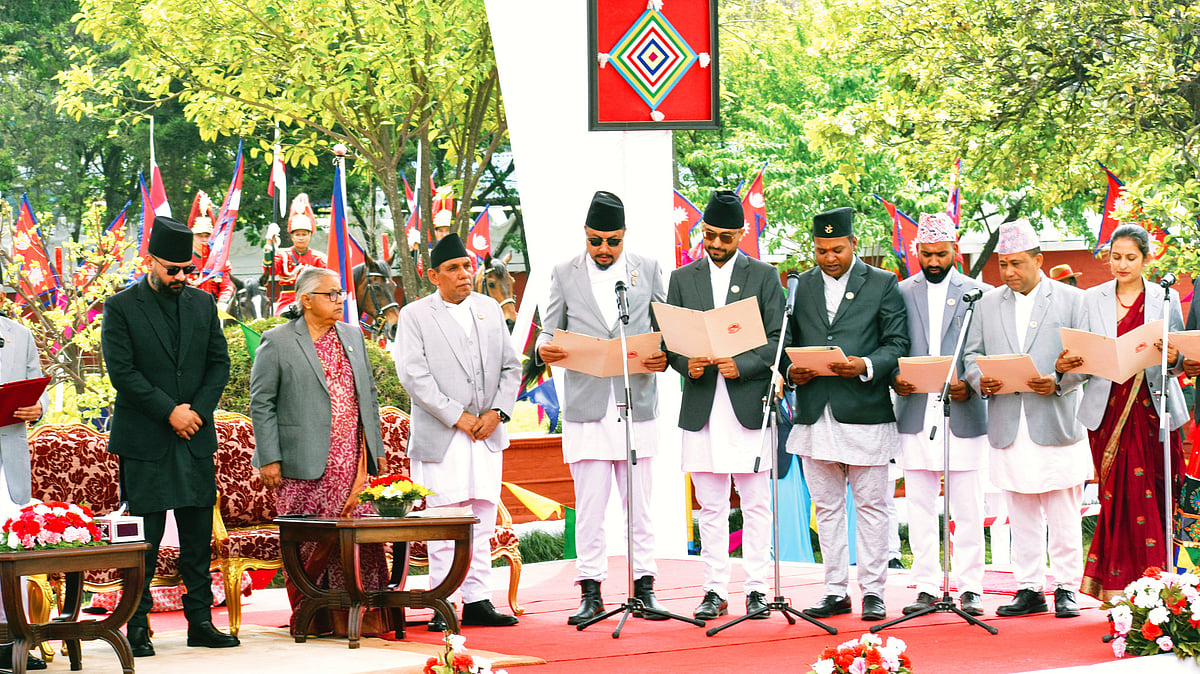
The new government in Nepal has hit the ground running, taking a bewildering array of decisions in its first week in office, leaving people guessing and gasping. The morning after the country's youngest-ever Prime Minister Balendra Shah (36) was sworn in on 27 March, the government authorised the arrests of former Prime Minister K.P. Sharma Oli and former home minister Ramesh Lekhak on charges of criminal negligence amounting to reckless homicide while suppressing the youth uprising of September 2025.
‘You messed with the wrong generation’, read new home minister Sudan Gurung’s cryptic social media post announcing the arrests. On 29 March, authorities arrested another former minister on money laundering charges and initiated investigations of corruption against three former prime ministers, including Oli.
On its second day in office, the government released a 100-point reform agenda. It instructed public and private hospitals to reserve 10 per cent of beds for economically disadvantaged patients with immediate effect and offered jobs at the national power authority to the families of those killed during the protests — an estimated 70.
The government also ordered the abolition of all student unions affiliated with political parties (an odd decision for a Gen Z government) and barred bureaucrats, teachers and other state-affiliated personnel from directly or indirectly engaging with political parties. Political appointees to various boards have been asked to step down voluntarily; if they don’t, the government seems determined to dismiss all 1,200 of them. A Bill has been introduced, proposing private schools be deemed ‘non-profit’ institutions.
Criticism from private schools, the bureaucracy and sections of the public has been overshadowed by the euphoria following the landslide victory of the Rastriya Swatantra Party (RSP), a young party formed in 2022. The idealistic youth who led the protests against the government and succeeded in overthrowing it in six months seems to hold out hope for a better future. For the moment, Nepal is basking in the afterglow of what had appeared impossible in August 2025.
The new government, however, faces formidable challenges. Its pre-poll promises — ensuring a GDP growth rate of seven per cent, creating 1.2 million jobs to prevent out-migration, turning Nepal into a $100 billion economy and an IT hub in the next five years — will require some luck and a lot of hard work. Opening a relatively closed economy in a land-locked country will demand innovative policies, as the government copes with rising aspirations, expectations of swift change and new economic opportunities.
PM Balendra Shah, who is also the first Madhesi (plains person) to hold the office, has a delicate balancing act ahead — with competing pulls and pressures from the dominant Khas-Arya ethnic groups and the Madhesis, Dalits and other marginalised groups.
Nepal’s government and politics has long been dominated by the high caste Khas-Arya hill people, who also control the judiciary and the bureaucracy. The people of Madhes, comprising 20 per cent of the population, are seen as culturally closer to Indians across the border, their loyalty to the nation suspect in the eyes of Nepal’s rulers.
To counter this, the Madhesis demanded greater political representation and devolution of power through federalism, both of which were achieved on paper but not in practice. Madhes opposition to the 2015 Constitution’s haphazard provincial delineation and unequal citizenship rights was fiercely countered by the Kathmandu elite, who saw the protests as driven by India.
Foreign minister Shishir Khanal has sought to dispel doubts about external affairs, declaring that Nepal would pursue non-alignment and uphold the country’s sovereignty, integrity and national interests. “There will be no change in the country’s foreign policy even if the government changes or a new minister comes,” he added.
With the prime minister and several of his ministers having studied in India, observers expect relations with India to improve. In the past, Balendra Shah has had to try extra hard to prove he was not tilting towards India, to the extent of putting up a map of ‘Greater Nepal’ in his mayoral office in response to the RSS map of ‘Akhand Bharat’.
****
Balendra Shah’s rise marks an important shift in Nepali politics. After three-and-a-half years as mayor of Kathmandu, he joined the RSP in January 2026, led it to a decisive victory in March as prime-ministerial candidate, and was installed as PM by the end of the month.
Shah — who is better known as a singer and rapper and holds a Master’s degree in structural engineering from Bengaluru — swiftly put together his cabinet of 14 ministers, five of them women and most of them from professional backgrounds.
Finance minister Dr Swarnim Wagle, for instance, is a well-known economist with a PhD from Australia. With 10 out of 15 ministers below the age of 40 and 20 per cent of the newly elected members of Parliament below the age of 30, it’s youth power to the fore.
No election has been as decisive since Nepal’s first general election in 1959, when the Nepali Congress (NC) won a two-thirds majority. The RSP’s parliamentary majority with 182 of 275 seats is only the second instance of single-party dominance since the NC’s win in 1999. Fragile coalitions dominated politics over the past two decades. While RSP chairman Rabi Lamichhane has reassured people that there would be no political vendettas, doubts persist.
It remains to be seen whether the hotheads among RSP supporters can be reined in. When Amisha Parajuli criticised Oli’s arrest as unconstitutional and vindictive on social media, she was attacked viciously — on social media.
The new government’s attitude to freedom of speech and freedom of the Press is ambivalent. In the past, despite tight restrictions the media was free to criticise even the panchayat system; it was bold enough to speak fearlessly against the majoritarian CPN Maoist-led government. Today’s media seems more circumspect, afraid of being mocked as jhole (blind followers or sycophants).
The Gen Z protests were carried out through social media, bypassing traditional media almost entirely. Given that the digital divide in Nepal is acute — 40 per cent of the people are still do not have access to the internet — the new government’s push for digital governance and reliance on digital and social media has caused unease. Political discourse, wrote a columnist, is being influenced by opaque social media algorithms.
As mayor of Kathmandu, Shah was known to have his way. A commentator wrote, ‘He combined old-school nationalism with a healthy disdain for the existing party system and traditional media. He chose to communicate primarily on social media with his millions of followers. He differed with ward chiefs over parking issues, bulldozed illegal constructions, displaced landless squatters and street vendors, and faced intense opposition from scrap dealers.’ His profanity in now-deleted social media posts, directed at both neighbouring countries and other Nepali leaders, caused concern.
The uphill task of guiding Nepal through turbulent times rests with a former rapper (Shah), a former DJ (Gurung) and a former talk show host (Lamichhane). Young, inexperienced and temperamental, they are impatient for change.
While the hopes of millions of citizens are riding on this trio, commentators in Kathmandu are busy speculating whether Balen Shah will end up adopting the governance style of Narendra Modi or Arvind Kejriwal.
Uddhab Pyakurel is associate professor of Political Sociology at Kathmandu University
Join our official telegram channel (@nationalherald) and stay updated with the latest headlines