POLITICS
Who’s taking on the BJP in Bengal?
In the recent Assembly polls, more people voted against the BJP than for it, leaving ample space for the Opposition to regroup
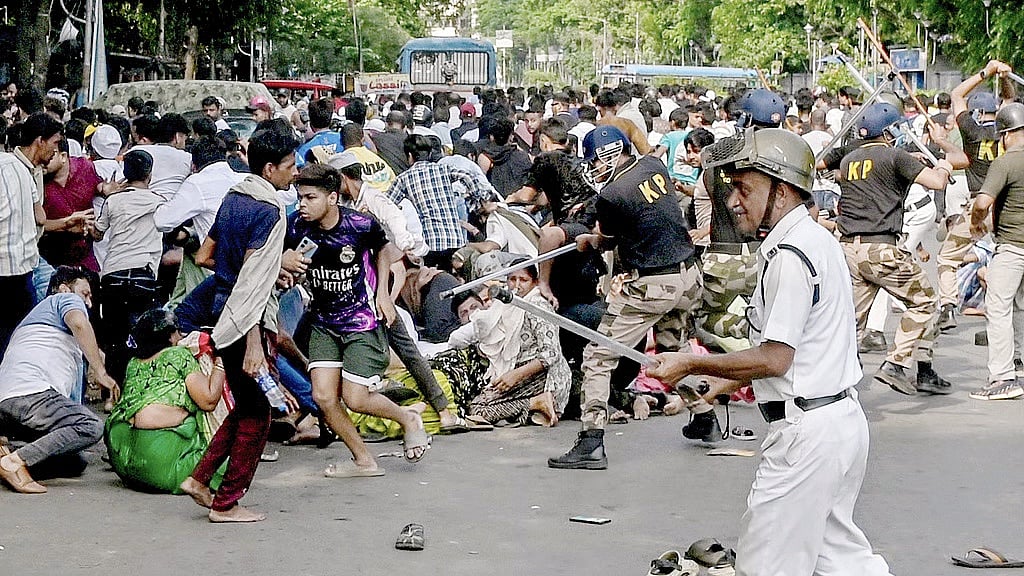
Assembly elections have decisively installed the BJP in power in West Bengal with 208 seats. It has reduced the Trinamool Congress to a rump opposition with 80 seats. Other parties in the fray — CPI(M), Congress, ISF — no longer matter in the grand scheme of things. In terms of vote share, however, more people voted against the BJP than for it, leaving a wide-open space for the Opposition to regroup.
In this two-part series, we try to decode how this space might shape up, who the possible players could be, what kind of political challenges they may pose (if any), and what kind of pressure they may bring to bear when it comes to framing policies and addressing issues.
Since his swearing in on 9 May, West Bengal’s new chief minister Suvendu Adhikari seems to be a man in a tearing hurry. Bulldozers were despatched to clear roads and demolish structures (including in Kolkata’s iconic Hogg Market). Government employees were issued gag orders. Hawkers were evicted from railway platforms. A dissenter like Garga Chatterjee was put behind bars. The West Bengal Animal Slaughter Control Act, 1950, was invoked and operationalised to regulate the slaughter of cows in the run-up to Eid and beyond.
‘Holding centres’ — a euphemism for detention camps — were set up to confine people suspected of being illegal Bangladeshi nationals. (Last heard, 12 inmates were moved into shelters in Murshidabad and Malda.) Acres of land were handed over to the Border Security Force to ‘strengthen border security’ with barbed-wire fencing.
Sealing off the India-Bangladesh border was part of the BJP’s campaign promise to justify its narrative of the illegal influx of Bangladeshi Muslims into West Bengal, which, the party proclaimed, was changing the state’s demography. This was the justification for the SIR which eventually struck 34 lakh people off the voter list. The BJP won the election by a margin of 30 lakh votes.
Kolkata’s tony living rooms and a pliable media have lapped up the BJP’s moves, interpreting them as essential to dismantle the TMC’s network of corruption and appeasement.
Mid-level BJP leaders say it’s all part of an essential consolidation of the BJP’s fledgling support base. The winning party’s overwhelming majority in the Assembly loses much of its sheen when seen in the light of the percentage of votes it has won — 45.84 per cent against the TMC’s 40.8 per cent. In fact, even after the deletion of 34 lakh names, more of West Bengal’s 6.5 crore voters have voted against the BJP than for it.
The bulk of these anti-BJP voters are still aligned with the TMC. This, along with the CPI-M (4.45 per cent), Congress (2.97 per cent) and others (5.94 per cent), defines the contours of West Bengal’s opposition space — now up for grabs among the state’s political parties.
****
The TMC, which was confident of a fourth stint, faces the clear and present danger of becoming irrelevant less than a month after the results. The loss of around seven per cent votes pushed it overnight from ruling party to Opposition. In hindsight, the writing on the wall was clear. And now come early signs of a TMC meltdown.
There is open dissent against Abhishek Banerjee. Around ten MLAs stayed away from a crucial post-election strategy meeting convened by Mamata Banerjee on 6 May. A flurry of councillors from municipal and other elected bodies have resigned. There are reports of elected MLAs approaching the Congress or the CPI-M. Speculation is also rife about TMC MLAs joining the BJP.
On 26 May, MP Kakoli Ghosh Dastidar, along with six TMC MLAs, attended an administrative meeting convened by Adhikari. (This was after she was replaced as the TMC’s parliamentary chief whip.) Ghosh Dastidar has since resigned from all her party positions.
Many TMC MLAs believe the party’s organisational structure has weakened due to over-centralisation around the figure of Mamata Banerjee and her coterie. Leaders who once enjoyed local authority feel politically insecure after the defeat. Some fear investigation, others fear losing relevance in a BJP-dominated Bengal.
Is there a viable Opposition in West Bengal, and if yes, what does it look like?
“For a variety of reasons, there has been a steady decline in West Bengal’s non-BJP vote share, especially since the 2021 elections. Non-TMC opposition parties have suffered a similar decline, although they are under the illusion that no such thing has happened,” explains political scientist Ranabir Samaddar, alluding to the falling vote share of both the CPI(M) and the Congress.
Samaddar points out two other reasons why a robust Opposition may prove elusive. One, the inability to set an alternative agenda. In 2016, the TMC was able to launch schemes like Kanyashree or Sabuj Sathi, which signalled a recognisable departure in the way social welfare was packaged. In 2021, the Paray Samadhan component of Duare Sarkar (government at your doorstep) redefined the last-mile delivery of governance.
Had the TMC won in 2026, what would it have brought to the table? Perhaps Rs 1,700 instead of Rs 1,500 under Lakshmir Bhandar, Rs 7 lakh instead of Rs 5 lakh under Swastha Sathi. Its web of corruption and rent-seeking would still have flourished. The TMC, in Opposition, is not in a position to set an alternative agenda. Not because it lost, but because it has run out of ideas.
Addressing law and order and human rights issues had long gone off the party’s radar. In fact, by agitating on the hawkers’ issue and demanding their rehabilitation before eviction, it is the CPI(M) that has kept the Opposition space alive. Its 'aagey Ram, porey baam (Ram first, Left next) line may sound fanciful, but the party is finally a presence on the streets.
The second impediment is that governments in West Bengal, once voted to power, do not change as frequently as they do in states like Karnataka, Kerala or Rajasthan. “This is because in West Bengal, legislative politics is interlaced with the politics of the street in a fundamental way,” Samaddar told National Herald. “As a result, it becomes difficult to change a party that comes to power with an agenda.” In this context, harping on the TMC’s corruption and governance failures is the BJP ecosystem’s all-out effort to stymie any alternative agendas.
Having said that, the BJP is also fumbling. Even after 20 days in the saddle, it has not been able to announce a fully-functional cabinet. To stave off any influx of TMC discards, BJP state president Samik Bhattacharya had initially announced that the party’s doors were closed for TMC workers. However, it only took 10 days for Bhattacharya to do a volte face, saying the BJP would welcome “good Trinamool workers”, indicating a dearth of ground-level mobilisers and leaders in their present set up.
Meanwhile, its policy regulating cow slaughter has backfired. With Muslims deciding not to buy cows, the livelihood of lakhs of Hindu livestock farmers has been affected. The gag order and stay on releasing DA instalments has made government employees restive. Could these become the building blocks of an alternative agenda for the Opposition?
For the moment, it’s all up in the air. The BJP dominates the Assembly but not the streets. The TMC is struggling to hold itself together. The Congress and the Left are still searching for a foothold.
What will emerge from this churn is anybody’s guess.
Sourabh Sen is a Kolkata-based independent writer and commentator on politics, human rights and foreign affairs. More of his writing here
Join our official telegram channel (@nationalherald) and stay updated with the latest headlines